

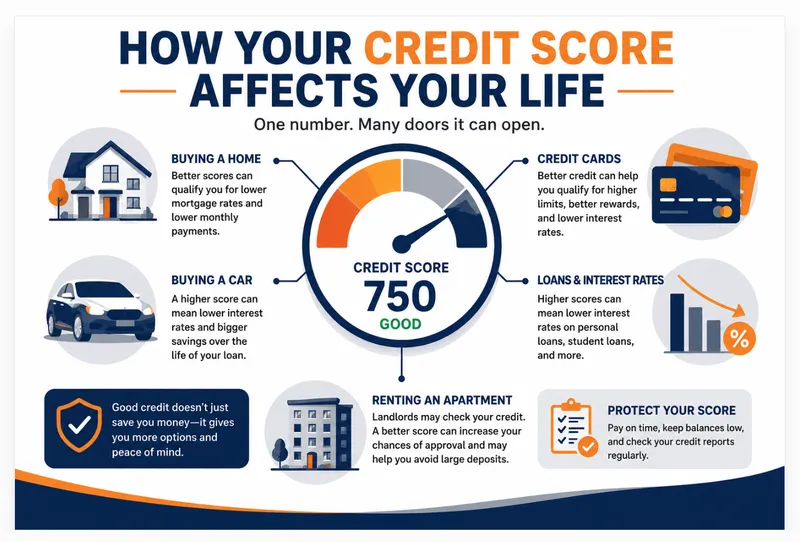
How your credit score affects your life goes far beyond loan approvals.
Your three-digit score shapes your mortgage rate, car insurance premium, and apartment application. It also affects your cell phone plan, utility deposits, and in some states, your job prospects.
A low score does not just mean higher interest.
It means paying more for almost everything.

Running a credit repair company, I hear the same surprise from clients every week.
One of the most unforgettable cases I worked on was a 33-year-old nurse who came in after being denied an apartment. She had a steady income and no missed payments in two years. But she had two old medical collections from 2019 that she did not know were still on her report. Her score sat at 601. The landlord required a minimum of 650. She lost the apartment.
Three weeks later.
After we disputed and removed one verified error, her score hit 648. She still lost that unit. The next application, at 648, went through with a larger deposit. A number. Two digits apart. It cost her an apartment and a month of her life.
This relfects on data as well. A 2025 Federal Reserve Bank of New York study confirmed how broadly credit affects daily decisions. Rejection rates on credit cards, auto loans, and mortgage applications all reached multi-year highs in 2024. More than 48% of applicants reported at least one denial in the past 12 months (source). Many had jobs, income, and a clean recent history. Their scores were just below the threshold. The threshold is everywhere.
How Your Credit Score Affects Your Life Financially
Your credit score becomes especially important when you need to borrow money. Lenders can use your credit score along with your income, debt, and other information to decide whether to approve your application and what terms to offer.
That difference can cost you real money.
For example, two people could finance the same car but receive different interest rates because their credit profiles are different. The borrower who qualifies for the lower rate may pay considerably less interest over the life of the loan.
The same principle can apply when you apply for a mortgage or credit card. Your credit can influence the rates, credit limits, and financing options available to you.
That is why your score is more than just a three-digit number. What matters is how that number affects the financial opportunities available to you and how much those opportunities ultimately cost.
How Does Your Credit Score Affect Your Mortgage Rate?
Your credit score is one of the biggest factors in your mortgage rate. As of early 2026, a top-tier score near 800 earns an APR around 6.41 percent on a 30-year fixed mortgage. On an average-sized $378,384 loan, the gap between the best and worst credit tiers costs roughly $168 more per month and about $60,447 in extra interest over 30 years.
No area of your financial life feels the number more than a mortgage. Curinos rate data compiled for myFICO shows that gap holding through 2026: a borrower at 800 gets meaningfully better pricing than a borrower in the low 600s on the same loan amount and term. Mortgage lenders pull all three bureaus and use your middle score. Apply with a co-borrower, and lenders use the lower of the two middle scores, so one weak score raises the rate for both of you.
| Credit Score Tier | Mortgage Rate Impact | What It Means |
|---|---|---|
| 760-850 | Lowest available rates | Top pricing tier, best terms |
| 700-759 | Competitive, slightly above top tier | Strong approval odds |
| 680-699 | Acceptable but noticeably higher | Still qualifies for conventional loans |
| 660-679 | Rates rise meaningfully | Monthly payments increase |
| 620-639 | Highest conventional rates | Some lenders decline |
| 580-619 | Conventional options narrow | FHA loans possible with 3.5% down |
How Does Your Credit Score Affect Car Insurance Rates?
In most states, insurers use a credit-based insurance score to help set premiums. A 2026 Insurify analysis found drivers with poor credit pay about $2,602 a year for full coverage versus $1,853 for drivers with excellent credit, a 40 percent gap. California, Hawaii, Massachusetts, and Michigan ban insurers from using credit scores at all.
About 95 percent of auto insurers use a credit-based insurance score in underwriting, according to FICO. That score is not your FICO score, but it draws from the same report data: payment history, debt, account age, and inquiries. The Insurify 2026 rate survey puts the national gap at 40 percent, and Bankrate's late-2025 study found it can reach 105 percent by carrier. Your insurer cannot deny coverage over credit alone, but they can charge more, so shopping multiple quotes matters as much as the score itself.
How Does Your Credit Score Affect Renting an Apartment?
Most landlords and property management companies run a credit check before approving a lease, and many set a minimum score threshold between 650 and 700 in competitive rental markets. A low score does not always mean automatic denial, but it usually means a larger security deposit, a co-signer requirement, or several months of prepaid rent.
Large property management companies tend to run automated systems: a score below their threshold triggers denial without further review. Smaller, private landlords are often more flexible and may weigh a clean rental history more heavily than the raw score. A 580 score with a clean rental record can sometimes get approved where a 650 with an eviction on file will not.
How Does Your Credit Score Affect Auto and Personal Loan Rates?
Auto loan rates in Q1 2026 ranged from about 4.55 percent for superprime borrowers to 16.01 percent for deep subprime borrowers on new cars, according to Experian. Personal loan APRs follow a similar pattern, with excellent-credit borrowers averaging under 15 percent and poor-credit borrowers sometimes facing rates near the legal maximum of 36 percent.
Personal loans price the same way. Borrowers with scores above 720 averaged under 15 percent APR in mid-2026, while sub-580 borrowers routinely see offers near 36 percent, the legal ceiling for most personal loans. On a $10,000 loan over three years, that spread alone can mean thousands of dollars in extra interest for the same amount borrowed.
Qualifies for the lowest auto and personal loan rates, plus rewards and cash-back credit cards with no security deposit required.
Often limited to secured cards, subprime auto financing, and personal loans priced near the legal maximum APR.
Can Employers Check Your Credit Score in 2026?
In most states, employers can request a modified version of your credit report for certain roles, especially financial and security-sensitive positions, with your written permission. Eleven states now restrict or ban the practice for most jobs, including New York, which added a statewide ban effective April 18, 2026.
Employers see a modified version of your credit report, not your actual score, and what they check depends on the role. Financial roles, security clearance positions, and some management jobs are the most common places a credit history review appears. As of 2026, California, Colorado, Connecticut, Hawaii, Illinois, Maryland, Nevada, New York, Oregon, Vermont, and Washington restrict or prohibit employer credit checks for most positions, and New York's statewide ban took effect in April 2026, joining its existing New York City law. Employers must get written permission first, and a soft inquiry is used, so it will not affect your score.
Add the categories together and the gap between a 580 score and a 750 score can exceed $100,000 across a lifetime. It is not just a number. It is the price you pay, or do not pay, for almost everything.
How your credit score affects your life shows up in every major expense category: mortgage rates, insurance premiums, rental applications, loan pricing, and in eleven states, employment screening. The gaps are large and well documented in 2026 data, but they are also reversible. Correcting errors and lowering utilization can move you between tiers faster than most people expect.
- ✓ Pull your credit report from all three bureaus and check for errors before applying for anything
- ✓ Dispute inaccurate or unverifiable accounts, since even one error can hold a score below a lender's threshold
- ✓ Know your tier before you shop for a mortgage, car loan, or insurance policy
- ✓ Get multiple insurance quotes, since the same credit score can price very differently by carrier
- ✓ Check your state's employment credit check law if you are job hunting in a financial or security role
How does your credit score affect your mortgage rate?
Your credit score is one of the biggest factors in your mortgage rate. As of early 2026, a top-tier score near 800 earns an APR around 6.41 percent on a 30-year fixed mortgage, while a score in the low 600s can push that rate meaningfully higher. On an average-sized $378,384 loan, the gap between the best and worst credit tiers costs roughly $168 more per month and about $60,447 in extra interest over 30 years.
How does your credit score affect car insurance rates?
In most states, insurers use a credit-based insurance score to help set premiums. A 2026 Insurify analysis found drivers with poor credit pay about $2,602 a year for full coverage versus $1,853 for drivers with excellent credit, a 40 percent gap. California, Hawaii, Massachusetts, and Michigan ban insurers from using credit scores at all.
How does your credit score affect renting an apartment?
Most landlords and property management companies run a credit check before approving a lease, and many set a minimum score threshold between 650 and 700 in competitive rental markets. A low score does not always mean automatic denial, but it usually means a larger security deposit, a co-signer requirement, or several months of prepaid rent.
How does your credit score affect auto and personal loan rates?
Auto loan rates in Q1 2026 ranged from about 4.55 percent for superprime borrowers to 16.01 percent for deep subprime borrowers on new cars, according to Experian. Personal loan APRs follow a similar pattern, with excellent-credit borrowers averaging under 15 percent and poor-credit borrowers sometimes facing rates near the legal maximum of 36 percent.
Can employers check your credit score in 2026?
In most states, employers can request a modified version of your credit report for certain roles, especially financial and security-sensitive positions, with your written permission. Eleven states now restrict or ban the practice for most jobs, including New York, which added a statewide ban effective April 18, 2026.
Don't Let Your Credit Score Cost You Thousands
A collection account, a reporting error, or high utilization could be costing you far more than points, it could be costing you a lower mortgage rate, a cheaper insurance policy, or an approved lease. A free 3-bureau audit shows exactly what is on your report right now.
Get My Free 3-Bureau Audit → Secure · 2 minutes · No credit card required-
What Credit Score Do You Need for a $400,000 House? Breaks down the exact score thresholds for FHA and conventional loans and how much a higher score saves over 30 years.
-
Yes, 750 Is a Good Credit Score, Here's What It Gets You Covers exactly which mortgage, auto, and credit card products open up once a score clears the 750 mark.
-
How to Get Approved for a $20,000 Loan (Even With Bad Credit) Explains how lenders map credit score to approval odds and interest rate on a personal loan, with steps to improve your offer.