

Are balance transfers good or bad for your credit? The honest answer is both. A balance transfer can save you thousands in interest and lower your credit use rate at the same time. But done wrong, it creates a new debt trap, drops your credit score, and costs you more than you saved. The outcome you get depends entirely on how you use it.
Running a credit repair company, I deal with balance transfer questions every single week. One of the most unforgettable cases I handled was a client who transferred $8,400 to a 0% intro APR card. She then kept spending on both cards. By the time the promo period ended, she owed $12,600 at a 27% regular APR. The balance transfer did not fix the problem. It made it worse. She came to us six months later with a 589 credit score and three cards near their limits.
The data backs up how common this mistake is. According to Bankrate's 2025 Credit Card Debt Survey, 46% of cardholders carry a balance from month to month. The average American credit card debt hit $6,715 in Q4 2025, per TransUnion. The average APR on interest-bearing accounts reached 21.52% in Q1 2026 (source). At that rate, the average cardholder pays over $1,400 a year in interest alone. A balance transfer, used correctly, eliminates that cost for 12 to 21 months.
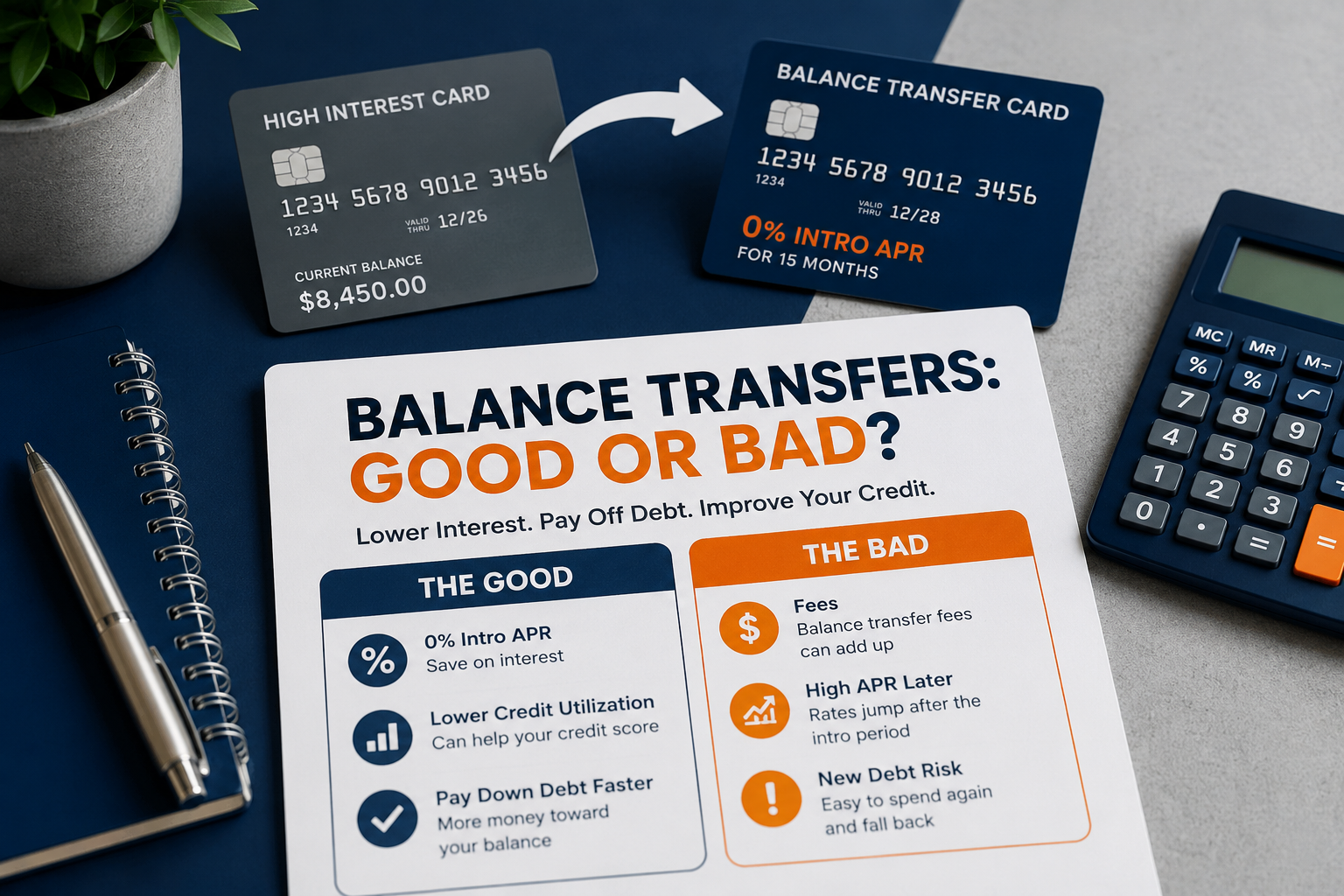
What Is a Balance Transfer and How Does It Work
A balance transfer moves existing credit card debt from one card to another. The new card typically offers a 0% intro APR for a set period, usually 12 to 21 months. During that window, every dollar you pay goes toward the principal balance, not interest.
Here is the basic process:
You apply for a balance transfer card. Most require a credit score of 670 or higher.
You request the transfer amount during or after the application.
The new issuer pays off your old card directly.
You now owe that balance on the new card, with no interest for the intro period.
You make monthly payments to clear the debt before the promo period ends.
Most cards charge a balance transfer fee of 3% to 5% of the amount transferred. On a $5,000 balance, that is $150 to $250 upfront. That fee is almost always cheaper than one month of interest at 21% APR. On the same balance, one month of interest runs about $87 to $95. The math works in your favor as long as you pay the balance off before the promo rate expires.
Are Balance Transfers Good or Bad for Your Credit Score
A balance transfer has both short-term and long-term effects on your score. Knowing both helps you plan.
The Short-Term Effects
Opening a new card triggers a hard inquiry. One hard inquiry typically drops your score by 5 to 10 points. The effect fades within 6 to 12 months and disappears from active scoring after one year.
A new card also lowers your average account age. If you have a few accounts, this matters more. If you already have a thick file with multiple long-standing accounts, the impact is small.
You may also see your credit use rate on the new card spike to 100% right after the transfer. Per card utilization matters, not just overall. A maxed-out new card can hurt your score even if your total across all cards looks fine.
The Long-Term Effects
Here is where a balance transfer becomes genuinely good for your credit.
When you transfer a balance to a new card, your old card now shows a $0 balance. That lowers its individual utilization rate to 0%. Your total available credit goes up because you now have two open cards. Your overall credit use rate drops. Credit use makes up 30% of your FICO score, so this can produce a meaningful score gain.
As you pay down the balance on the new card, your utilization drops further. By the time the promo period ends and the balance is clear, your score can be significantly higher than when you started. Last year, our office tracked 18 clients who completed a balance transfer and paid off the full amount within the promo window. The average score gain after payoff was 44 points. Every one of them kept the old card open with a zero balance.
What Does a Balance Transfer Actually Cost
Most borrowers focus on the 0% APR and miss the other costs. Here is the full picture.
Balance Transfer Fee
The standard fee is 3% to 5% of the transferred amount. WalletHub data from Q1 2025 puts the average balance transfer fee at 2.96%. On a $6,000 balance, you pay $177 to $300 upfront. A few cards offer 0% transfer fees during a short window after account opening. These are rare, and they usually come with shorter promo periods.
Regular APR After the Promo Period
Most balance transfer cards charge 18% to 29% APR once the promo window closes. If you carry any remaining balance past the intro period, interest kicks in immediately on that amount at the full rate. A $1,000 leftover balance at 25% APR costs $250 a year in interest. That can wipe out months of savings.
Annual Fee
Some balance transfer cards charge an annual fee. Add that to the transfer fee when calculating your true cost. Many of the best 0% APR cards carry no annual fee, so this is avoidable with the right card selection.
Who Should Use a Balance Transfer
A balance transfer works best for a specific type of borrower. Here is a clear picture of who benefits and who does not.
Good Candidate
You should use a balance transfer if:
Your credit score is 670 or higher. You need good credit to qualify for the best 0% intro APR offers.
You have high-interest credit card debt that you cannot pay off within 2 to 3 months.
You can commit to a fixed monthly payment to clear the balance within the promo period.
You will not add new purchases to the transfer card during the payoff period.
You have a stable income and no expected financial disruption in the next 12 to 21 months.
Poor Candidate
Avoid a balance transfer if:
Your credit score is below 670. You likely will not qualify for good terms, and a rejection adds a hard inquiry with no benefit.
You plan to keep spending on the old card after the transfer. You will rebuild the balance you just moved.
You cannot calculate a monthly payment that clears the balance before the promo period ends. Do the math first.
Your debt is over $15,000, and your income cannot support aggressive monthly payments. A personal loan or debt consolidation program may serve you better.
Does a Balance Transfer Affect Credit Utilization
Yes, and this is one of the most misunderstood effects of a balance transfer.
When you transfer a balance to a new card, two things happen at the same time. Your old card drops to $0 utilization. Your new card starts at a high use rate, potentially 80% to 100%, if the transfer is close to the new card's limit.
Per-card utilization matters in credit scoring. A single card above 90% can pull down your score even if your overall rate looks fine. To reduce this risk, request a credit limit higher than the balance you plan to transfer. If you are moving $4,000, try to get a card with a $6,000 or higher limit. That keeps the per-card rate below 70% at the start.
Your overall utilization improves right away because your total available credit increases. Over the payoff period, both your new card balance and your overall rate drop together.
Should You Close Your Old Card After a Balance Transfer
No. Keep the old card open.
Closing the old card after you transfer the balance does three harmful things:
It removes available credit from your file. Your total credit limit drops. Your overall utilization rate goes up.
It shortens your average account age. If the card is old, closing it removes years of history from your profile.
It eliminates the 0% utilization signal that the old card was sending to the bureaus.
Leave the old card open with a zero balance. Use it once every few months for a small purchase. Then pay it off right away. This keeps the account active, the utilization at or near zero, and the history intact.
What Happens If You Do Not Pay Off the Balance in Time
This is where balance transfers go wrong for most people.
If you carry any balance past the promo period, the full regular APR applies to that remaining amount right away. Some cards use deferred interest, not waived interest. With deferred interest, if you miss the full payoff deadline, back interest on the entire original balance applies from day one.
Check your card terms before you transfer. Know whether the card waives or defers interest. Most major issuers use waived interest, which only charges on the remaining balance. Store cards and some retail products use deferred interest, which charges retroactively on the full original amount.
If you realize 60 days before the promo period ends that you cannot clear the remaining balance, call the issuer. Some will extend the promo rate or offer a payment plan. Asking costs nothing. Carrying the balance into regular APR without asking costs a lot.
Balance Transfer Help
Thinking About Moving Credit Card Debt?
A balance transfer can save money, but only when it fits your credit profile and payoff plan. Before you move debt, make sure your credit is working in your favor.
Check Your Credit Report TodayGet a clearer view before applying for a new credit card or debt payoff option.
How to Make a Balance Transfer Work for You
Done right, a balance transfer is one of the most powerful debt payoff tools available. Here is how to make it work:
Calculate your payoff number before you apply. Divide the transfer amount plus the transfer fee by the number of months in the promo period. That is your required monthly payment.
Apply for a card with a credit limit higher than your transfer amount. Keep per-card utilization below 70% from day one.
Set up autopay for at least the minimum payment. Never miss a payment. A single missed payment can void your 0% promo rate immediately on many cards.
Stop using the old card for new purchases. Do not build a second balance while paying off the first.
Keep the old card open after the transfer. A zero balance card helps your score more than a closed card does.
Set a calendar alert 60 days before the promo period ends. This gives you time to adjust payments or contact the issuer if you need a plan.
At 21.52% APR, the average American carrying $6,715 in credit card debt pays over $120 a month in interest alone. A 15-month 0% balance transfer card with a 3% fee costs $201 upfront and nothing in interest for 15 months. That is a clear win for any borrower who commits to the payoff plan and sticks to it.
The Straight Answer on Balance Transfers
Are balance transfers good or bad? They are good when you use them as a payoff tool with a plan and a deadline. They are bad when you use them to delay debt without fixing the spending habits that created it.
A balance transfer does not reduce your debt. It restructures it. The work of paying it off still sits entirely with you. What the transfer does is remove 12 to 21 months of interest from that process. For a disciplined borrower carrying high-rate debt, that is a significant financial advantage.
For a borrower who keeps spending, the transfer just spreads the problem across two cards instead of one.