

TL;DR: Banks approve loan amounts based on risk, not the amount you request. Even if you qualify for a loan, the lender may reduce the amount because of your income, debt-to-income ratio, credit score, existing obligations, or internal lending guidelines. A smaller approval often means the bank believes you can repay that amount safely but views the full request as a higher risk.
If a bank approved your loan application but offered less money than you requested, it usually means the lender adjusted the loan amount based on its risk assessment.
Many borrowers assume approval is a simple yes-or-no decision. In reality, lenders evaluate how much debt a borrower can reasonably afford based on income, existing obligations, credit history, and internal underwriting standards.
According to Experian, lenders review multiple factors beyond credit score when making lending decisions. Two borrowers with identical scores may receive very different loan amounts because their income, debt levels, and financial profiles differ.
Understanding why lenders reduce approved loan amounts can help borrowers identify what factors influenced the decision and what steps may improve future borrowing capacity.
Why Did the Bank Approve Me for Less Than I Requested?
There are logical reasons behind these, which we try to illustrate on the infographic below:
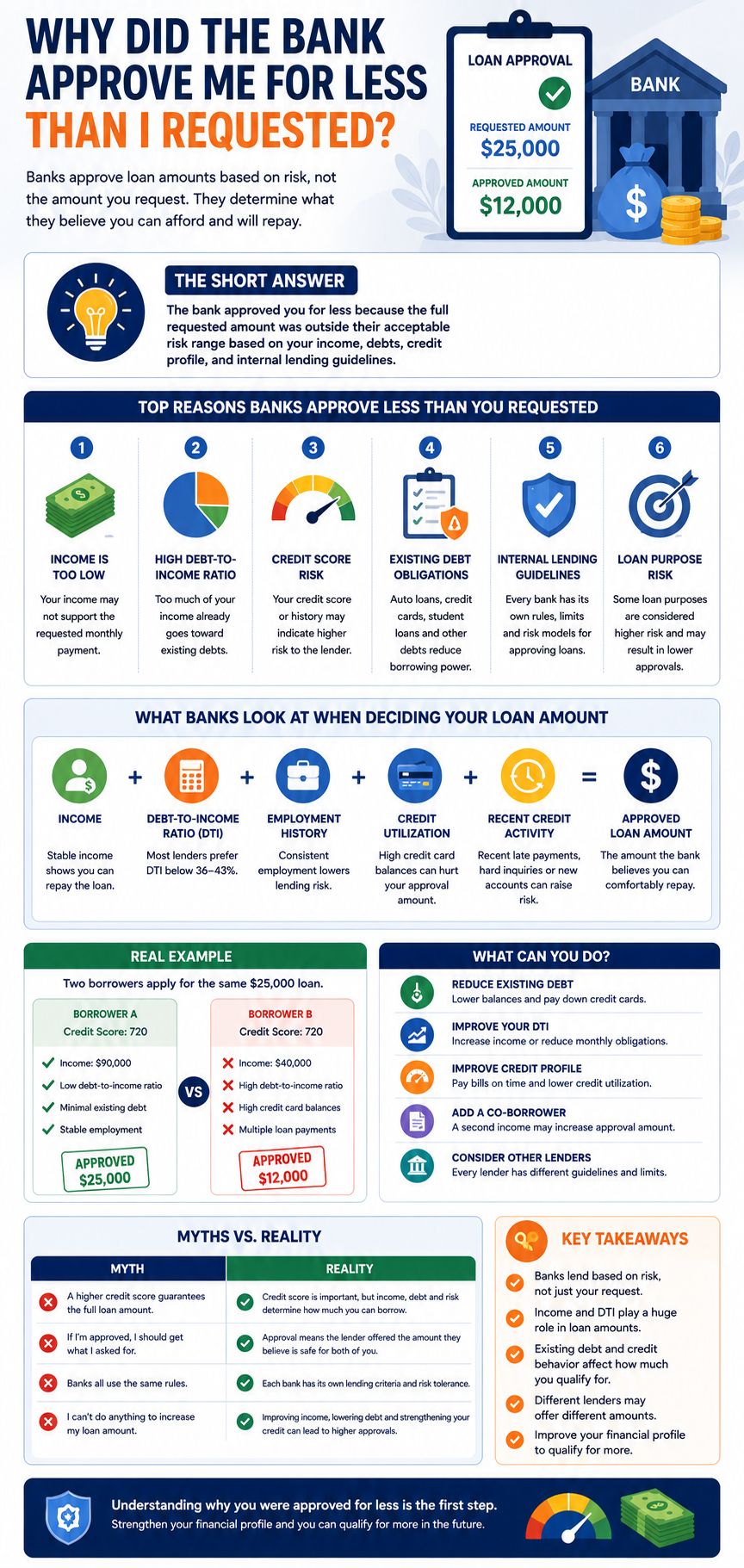
Why Did the Bank Approve Me for Less Than I Requested?
The bank approved less because its underwriting model determined the requested amount exceeded an acceptable risk level based on your income, existing debt, and credit profile. Lenders are not deciding whether you are a trustworthy person. They are calculating a single number: how much can this borrower repay without defaulting. Your requested amount was higher than that calculation allowed.
Most borrowers focus on the wrong question. They ask whether they will get approved. Lenders ask how much this borrower can realistically repay. Those are not the same question, and the gap between them produces reduced approvals.
Lenders run your application through an underwriting process that looks at your verified income, your existing monthly debt obligations, your credit history across Equifax, Experian, and TransUnion, your employment stability, and in some cases your cash flow or assets. The approved amount reflects what fits inside the lender's acceptable risk parameters after running all of those calculations together.
Your requested amount was the starting point. The lender adjusted it based on the data. Understanding which specific factor caused the reduction is the first step toward changing the outcome on a future application.
As a loan officer reviewing a reduced approval file would note, the most common pattern is a borrower whose credit history is strong enough to qualify but whose existing monthly obligations leave too little room for the new payment at the requested amount, and that gap between qualifying and qualifying fully is entirely addressable with the right steps taken in the right order.
How Do Banks Decide How Much to Approve?
Banks run your income, existing monthly debt payments, credit history, and employment stability through an underwriting model. That model calculates the maximum monthly payment you can handle at an acceptable risk level. The approved amount is whatever loan produces a payment at or below that calculated maximum. The requested amount plays no role in this calculation.
The lender's underwriting model produces a maximum monthly payment the borrower can handle at acceptable risk. The loan amount is whatever produces a payment at or below that ceiling. If your requested loan amount generates a payment above the model's output, the lender reduces the loan until the payment fits.
This is why two borrowers with the same 710 credit score can walk into the same bank and walk out with different offers. The borrower earning $85,000 with two manageable debts gets the full amount. The borrower earning $42,000 with four existing obligations gets a fraction of what they requested. Same score, entirely different financial pictures.
Is Income the Biggest Factor in a Reduced Loan Approval?
For most personal loan reductions, income is one of the two largest drivers. It determines directly whether the monthly payment for the requested amount is affordable. A credit profile strong enough to qualify for a loan is not the same as an income high enough to support the requested payment amount.
Lenders run a payment-to-income calculation. They take the monthly payment for the loan you requested and compare it against your verified gross monthly income. If that payment consumes too large a share of your income, the lender reduces the loan amount until the payment falls within their acceptable range.
| Borrower | Annual Income | Credit Score | Requested | Likely Outcome |
|---|---|---|---|---|
| Borrower A | $38,000 | 710 | $25,000 | Reduced to $10,000–$13,000 |
| Borrower B | $85,000 | 710 | $25,000 | Full amount likely approved |
| Borrower C | $52,000 | 680 | $20,000 | Reduced to $8,000–$12,000 |
| Borrower D | $52,000 | 680 | $20,000 + co-borrower at $65,000 | Full amount more likely |
The lender is not rewarding Borrower B. It is calculating that B's income supports a larger monthly obligation without default risk. The math is the same for both borrowers. The inputs are different.
From the perspective of a financial counselor reviewing a reduced approval with a client, the most immediate question is always whether additional income sources exist that were not included in the original application, because verified rental income, freelance income documented on Schedule C, or a second job with at least 24 months of history can all change the calculation materially.
How Does Debt-to-Income Ratio Reduce the Approved Loan Amount?
Debt-to-income ratio, called DTI, measures your total monthly debt payments against your gross monthly income. Most lenders prefer DTI below 36%. Many allow up to 43% for personal loans. Above 43%, the lender reduces the approved amount to bring the new payment back inside their threshold, or denies the application entirely. This happens regardless of credit score.
According to the 2024 National Association of Realtors Home Buyers and Sellers Generational Trends Report, 48 percent of prospective homebuyers were denied a mortgage because of DTI. A similar pattern applies to personal loans and auto loans. High DTI is the single most common structural reason a borrower qualifies for a loan but not for the amount they requested.
| Monthly Obligation | Payment |
|---|---|
| Auto loan | $450 |
| Student loan minimum | $310 |
| Credit card minimums (3 cards) | $240 |
| Proposed new loan payment at requested amount | $420 |
| Total Monthly Debt with New Loan | $1,420 |
| Gross Monthly Income | $5,000 |
| Resulting DTI | 28.4% existing + 8.4% new = 36.8% total |
The lender reduces the loan amount until the resulting payment brings DTI back below their threshold. If that means approving $10,000 instead of $25,000, that is the number they offer.
Can a Good Credit Score Still Result in a Lower Approval?
Yes. A credit score measures how you have managed debt historically. It does not measure how much additional debt you can carry right now. A borrower with a 740 score and $1,400 in existing monthly obligations on a $48,000 salary can receive a smaller approval than a borrower with a 680 score and $300 in monthly obligations on a $75,000 salary.
The score opens the door. Everything else determines how far you walk through it.
Real Example: 720 Score, Approval Cut in Half
A borrower applied for a $25,000 personal loan with a 720 FICO score and no missed payments in three years. The bank approved $11,500. The file showed two active auto loans with a combined monthly payment of $780, four credit cards all above 65% utilization, and a student loan balance of $41,000. Total existing monthly obligations exceeded $1,400 on a $56,000 annual income. The lender's underwriting model produced a maximum affordable payment well below what the $25,000 loan required. The score qualified the borrower for a loan. The debt load set the ceiling on the amount.
As an underwriter reviewing files for a regional bank would confirm, the first document checked on any reduced approval is always the existing obligation summary, because a score above 700 almost never drives a reduction by itself, but a score above 700 sitting on top of three or four existing installment payments on a mid-range income produces a reduced offer in a significant share of applications.
What Other Factors Reduce the Approved Loan Amount?
Beyond income and DTI, six secondary underwriting factors push the approved amount below the requested amount. Most borrowers are not aware of all of them before they apply.
| Factor | How It Reduces the Amount | Risk Level |
|---|---|---|
| Recent late payments (last 12–24 months) | Signals active repayment stress, not just historical behavior. Underwriters weight recent delinquencies more heavily than older ones. | High |
| Credit utilization above 70% | Reduces FICO score significantly and signals reliance on revolving debt. Both effects lower the approved amount. | High |
| Open collection accounts | Treated as active financial instability. FICO 8, the most common personal loan scoring model, penalizes open collections heavily regardless of balance size. | High |
| Short employment history under 12 months | Reduces income stability score in underwriting models. Most lenders want 24 months at the same employer or in the same field. | Moderate |
| Multiple hard inquiries in 90 days | Signals urgent borrowing need. More than two or three hard pulls in a short window can reduce both the score and lender confidence. | Moderate |
| Loan purpose flagged as higher risk | Some lenders apply stricter caps to debt consolidation, business-related requests, and large unsecured loans. The purpose stated on the application triggers different underwriting rules. | Moderate |
From the perspective of a consumer rights attorney reviewing a client's credit file before a loan application, the most immediately actionable items are always open collections with incorrect dates or balances and credit cards above 70% utilization, because both can be addressed within 30 to 60 days and both produce measurable score improvements that directly affect what underwriting models calculate as the maximum safe loan amount.
Is Your Approved Amount Lower Because of Errors You Did Not Put There?
Inaccurate collection accounts, re-aged delinquencies, and wrong balances all suppress what a lender is willing to approve. A free 3-bureau audit shows exactly what Equifax, Experian, and TransUnion report right now and which entries are disputable under the Fair Credit Reporting Act.
Get My Free 3-Bureau Credit Audit → Secure · 2 minutes · No credit card requiredWhat Can You Do If the Approved Amount Is Too Low?
You have five options. Each one targets a different root cause. The right option depends on which specific factor drove the reduction in your case. Identifying the cause first prevents wasting a hard inquiry on a reapplication that will produce the same result.
Some lenders will reconsider the approved amount if you provide documentation of income not included in the original application. Rental income, freelance income with 24 months of tax returns, a secondary job, or a recent raise documented by a current pay stub can all support a reconsideration request. Submit in writing, address it to the underwriting department, and reference the original application number.
Timeline: 5–10 business days | No hard inquiry required for reconsideration at same lenderA co-borrower changes the income side of the underwriting calculation. The lender now evaluates two income sources against the combined debt load. This is the fastest path to the full requested amount without changing your own financial profile first. Both borrowers are equally responsible for repayment, which is a commitment to discuss clearly before applying jointly.
Timeline: New application required | Most effective single action for income-driven reductionsEliminating one installment loan or paying credit cards below 30% utilization drops DTI and increases the score simultaneously. Both changes move in the direction the underwriting model needs. Paying one credit card from 80% utilization to 10% can produce 20 to 40 score points within a single billing cycle. Eliminating a $350 monthly auto payment drops DTI by 7 percentage points on a $5,000 monthly income. Either action alone can shift the approved amount meaningfully.
Timeline: 30–60 days | Most effective for DTI-driven reductionsThe CFPB found in 2024 that approximately 1 in 5 consumers has at least one error on their credit report. Inaccurate collection accounts, wrong balances, duplicate entries, and accounts with incorrect dates all suppress scores and inflate the risk picture lenders see. Disputing and removing these items under the Fair Credit Reporting Act can shift a score by 30 to 60 points in one dispute cycle. That score shift changes the risk tier the underwriting model assigns you, which directly changes the approved amount ceiling. ASAP Credit Repair USA reviews all three bureau reports and builds dispute packages targeting every entry that does not meet FCRA reporting standards, with a 73% average deletion rate and a 100% money-back guarantee on fees paid for work that does not produce a result.
Timeline: 30–45 days per dispute cycle | Most effective for score-driven reductions involving inaccurate dataEvery lender uses a different underwriting model. One lender may weight credit score heavily. Another may weight income. A credit union may use manual underwriting and consider member relationship history. An online lender like Upstart may use education and employment field alongside traditional credit data. The CFPB recommends prequalifying with at least three lenders before submitting a full application. Prequalification uses a soft inquiry and does not affect your score. The same borrower profile can produce meaningfully different offers from different institutions in the same week.
Timeline: Prequalification results in minutes | No score impactWhy Did Another Lender Offer Me More?
Every lender uses a different underwriting model. The same borrower profile can produce significantly different approved amounts from different institutions in the same week. This is not an inconsistency. It is the result of each lender applying different weights to the same inputs.
Credit unions typically use more manual underwriting and may give more weight to member relationship history, consistent deposit activity, and length of membership. Online lenders like Upstart use machine learning models that factor in education and employment field alongside traditional credit data. Regional banks often apply stricter DTI cutoffs than community banks. National banks may weight employment stability more heavily than credit score.
Shopping multiple lenders through prequalification before submitting a full application is the highest-value step a borrower can take after receiving a reduced offer. Prequalification uses a soft inquiry. It does not affect the score. The CFPB recommends comparing at least three lenders before accepting any single offer.
How Does Credit Repair Help You Qualify for a Higher Loan Amount?
Credit repair targets inaccurate items on your report. Removing them changes the score and risk picture the lender sees. That change directly affects the ceiling the underwriting model sets on your approved amount. It does not create a new financial reality. It corrects the one that already exists so lenders see an accurate picture of your credit behavior.
The Fair Credit Reporting Act gives every consumer the right to dispute any item on their credit report that is inaccurate, unverifiable, or incomplete. When a bureau receives a valid dispute, it must investigate within 30 days and remove the item if the furnisher cannot verify it.
A collection account listed at the wrong balance suppresses your FICO score and signals higher risk to underwriters. Removing it changes both the score calculation and the risk picture simultaneously. An account showing a late payment that was actually a creditor billing error produces the same effect. These are not edge cases. CFPB data from 2024 shows that approximately 1 in 5 credit files contains at least one entry that does not accurately reflect the consumer's actual payment behavior.
Moving from a 600 score to a 660 score through dispute and utilization reduction can be the difference between being approved for $6,000 and being approved for $20,000. Moving from the subprime tier to the near-prime tier also changes the interest rate offered, which reduces the monthly payment, which further changes what the DTI calculation allows. The compounding effect of a score improvement is larger than most borrowers realize before they experience it.
From the perspective of a borrower who received a $9,000 approval on a $22,000 request, the most important step before reapplying is identifying which specific entries on the report drove the underwriter's risk calculation. Reapplying without that information produces the same result. Correcting the data first produces a different conversation with the next lender.
Why did the bank approve me for less than I requested?
The bank's underwriting model determined that the requested amount exceeded what your income, DTI, and credit profile support at acceptable risk. The reduced amount is what the model calculated as the highest safe loan for your current financial picture. The approval amount and the requested amount are evaluated independently. Your requested amount does not influence the calculation.
Can I negotiate a higher loan amount after receiving a reduced offer?
Yes. You can request reconsideration with additional income documentation, a letter explaining circumstances not captured in the application, or proof of a recent raise or new income source. Adding a co-borrower is the most reliable single action for increasing an approved amount quickly. Reducing existing debt before reapplying is the most reliable structural change for a future application.
Does income affect personal loan approval amounts more than credit score?
In many cases, yes. Income determines whether the monthly payment for the requested amount is affordable. Two borrowers with identical scores but different incomes will typically receive different approved amounts from the same lender. Income is one of the two most influential factors in setting loan amounts. DTI is the other.
What DTI do lenders want for a personal loan?
Most personal loan lenders prefer DTI below 36%. Experian confirms that many personal loan lenders allow up to 50% DTI with compensating factors, but the most common approval threshold sits around 43%. Above 43%, lenders typically reduce the approved amount to bring the new payment back inside their threshold. Below 36% is where the strongest approvals consistently happen.
Can credit repair help me qualify for a higher loan amount?
Yes. Removing inaccurate collection accounts, correcting wrong balances, and reducing utilization through the FCRA dispute process changes the score and risk profile lenders evaluate. That shift changes what underwriting models calculate as your maximum safe loan amount. ASAP Credit Repair USA reviews all three bureau reports and targets every entry that does not meet FCRA reporting standards, with a 73% average deletion rate and a 100% money-back guarantee on fees paid for work that does not produce a result.
Why did a different lender offer me more than the first one?
Every lender uses a different underwriting model with different factor weights. One lender may emphasize credit score. Another may emphasize income or employment field. Credit unions often use manual underwriting that gives more weight to member history and relationship. Shopping at least three lenders through prequalification before submitting a full application exposes the range of what your profile qualifies for across different models, at no cost to your credit score.
Find Out What Is Limiting Your Loan Approval Before You Reapply
A free 3-bureau audit shows exactly what Equifax, Experian, and TransUnion report right now, which entries are inaccurate, and what a realistic improvement timeline looks like. 20+ years in business. 3,000+ five-star reviews. 100% money-back guarantee on inaccurate item removal.
Get My Free Credit Blueprint → Secure · No hard inquiry · No credit card required-
Can a Debt Collector Add Interest Charges to Your Unpaid Debts? CBS News · November 2025 — Collection accounts and the interest added to them directly affect your DTI and your credit score. This covers what collectors can legally add, what violates the FDCPA, and how ballooning collection balances affect your borrowing capacity and loan approval amounts.
-
What Debt Collectors Can and Cannot Do If You Owe Money CBS News · January 2025 — Understanding FDCPA protections matters when an open collection account is suppressing the loan amount a lender will approve. This covers what collectors are prohibited from doing and what rights consumers have to dispute collection entries affecting their credit file.
-
7 Things Debt Collectors Are Required to Tell You CBS News · January 2025 — Collectors must provide an itemized breakdown of every fee and interest charge. If any of those charges appear incorrectly on your credit report and are suppressing your loan approval, this covers the disclosure rules that form the basis for disputing inaccurate collection entries.