
Tradelines are one of the most misunderstood tools in credit repair.
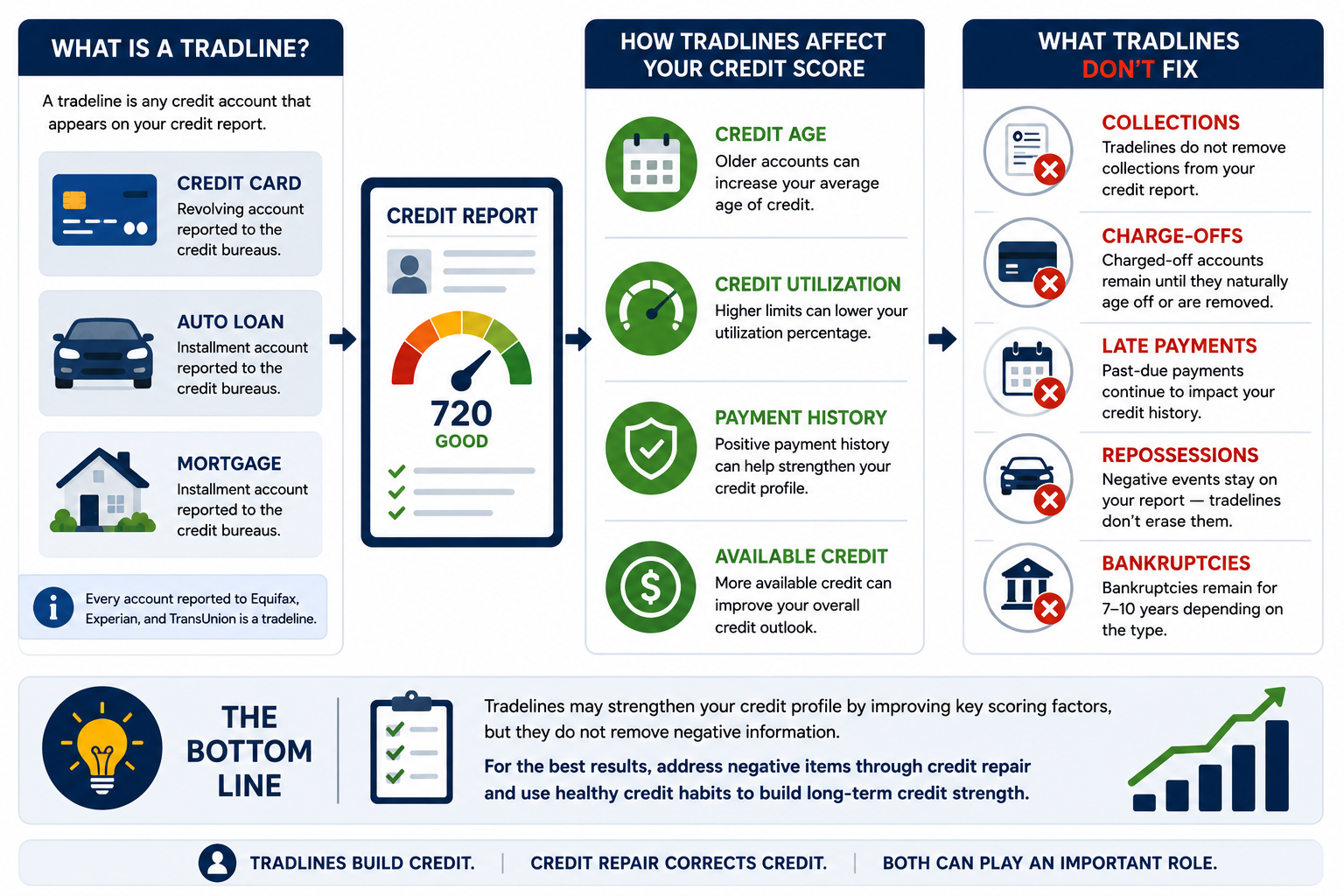
Many consumers believe tradelines automatically increase credit scores or erase negative credit history. In reality, a tradeline is simply a credit account that appears on a credit report. Every credit card, auto loan, mortgage, and line of credit reported to the credit bureaus is considered a tradeline.
The confusion usually begins when consumers hear about authorized user tradelines. These arrangements allow someone to be added to another person's credit card account, potentially benefiting from the account's age, payment history, and available credit. While tradelines can influence credit scoring factors in certain situations, they do not remove collections, eliminate charge-offs, or replace the credit repair process.
Understanding what tradelines can and cannot do is essential before spending money on tradeline services or expecting immediate credit score improvements.
What Are Tradelines in Credit Repair and Do They Work?
Tradelines are credit accounts that appear on a credit report. In credit repair discussions, the term usually refers to becoming an authorized user on someone else's credit card account to potentially benefit from that account's age, payment history, and credit limit.
While tradelines may influence credit scores in some situations, they do not remove negative items, correct reporting errors, or guarantee loan approval.
"I've seen people spend $800 on tradelines when what they primarly needed was to pay down one credit card. I've also seen tradelines produce a 40-point gain on a thin file when that was the only real problem. The confusion is that people treat tradelines as a cure-all. They're not. They're one tool. A specific tool for a specific problem. If your file has collections, late payments, or charge-offs, adding a tradeline doesn't fix those. A tradeline adds new positive information. It doesn't erase existing negative information. Those are diffrent things. Most people who buys tradelines expecting to erase bad credit will be disappointed."
What Is a Tradeline
A tradeline is any credit account that shows on your credit report. It is that simple. Every credit card you have is a tradeline. Your car loan is a tradeline. Your mortgage is a tradeline. Even a collection account is a tradeline. The credit bureaus use tradelines to build your credit history and calculate your credit score.
Think of your credit report as a list of accounts. Each account on that list is a tradeline.
Each tradeline shows key data. This includes the account type, the balance, the credit limit, the payment history, and the account age. Lenders look at all of this when they decide whether to approve you for a loan.
As Experian explains in their tradeline guide, tradelines include accounts where you are the primary borrower, a cosigner, or an authorized user. Each one appears separately on your credit report.
Examples of Tradelines
- Credit card from Chase, Capital One, or Discover
- Auto loan from a bank or dealership
- Student loan
- Personal loan
- Mortgage
- Medical collection account
- Authorized user account (someone else's card)
How Tradelines Affect Credit Scores
Tradelines affect four parts of your FICO score. Payment history (35% of your score) records whether payments were made on time. Credit age (15% of your score) tracks how long accounts have been open. Credit utilization (30% of your score) shows how much of your available credit you are using. Credit mix (10% of your score) reflects the variety of account types you have. Adding a tradeline can help any of these areas, depending on what the account shows.
What Is an Authorized User Tradeline
An authorized user tradeline is when someone adds you to their credit card as an authorized user. You don't have to use the card. You don't even have to get a physical card. The card's history, credit limit, and payment record appears on your credit report. If the card has a long history and low balance, it can raise your score. This is what people usually mean when they talk about buying tradelines.
Here is how it works step by step.
- Person A has a credit card open for 10 years. Low balance. Perfect payment history.
- Person A adds Person B as an authorized user on that card.
- The card appears on Person B's credit report as if Person B has used it for 10 years.
- Person B's score may go up because of the added age, available credit, and clean history.
Family members do this all the time. Parents add adult children to their cards to help them build credit. This is legal and accepted by lenders.
The issue comes when strangers sell authorized user access for money. A company connects buyers and sellers. The buyer pays $200 to $1,000. The seller adds the buyer to their card for 2 months. Then the buyer gets removed. The card shows up on the buyer's report as closed.
Do Tradelines Actually Work
Tradelines helps some people and do nothing for others. The result depends entirely on what problem you are trying to fix. If your file is thin , few accounts, short history , a tradeline can add age and available credit. That often raises the score. If your file has collections, charge-offs, or recent late payments, adding a tradeline adds positive data on top of negative data. The negative items keep pulling the score down. The tradeline cannot cancel them out.
- The file is thin with few accounts and short history
- The score is suppressed primarly by high utilization, not by derogatory items
- The borrower is a young adult with no derogatory marks
- The goal is to add a new account type to improve credit mix
- The existing accounts have a short average age
- Collections or charge-offs exist on the report
- Recent late payments in the past 12-24 months
- A repossession or bankruptcy in the past 2 years
- The mortgage application goes to manual underwriting
- The lender requires primary tradelines for qualification
What Tradelines Cannot Fix
Tradelines do not remove negative items. They cannot delete collections, charge-offs, late payments, repossessions, or bankruptcies. These items stay on the report regardless of how many tradelines are added. The only way to remove negative items is through FCRA disputes (when the item is inaccurate or unverifiable), pay-for-delete agreements, or waiting for the 7-year window to expire. A tradeline adds new positive data. It does not touch existing negative data.
| Credit Problem | Can Tradelines Fix It? | What Actually Fixes It |
|---|---|---|
| Collection account on report | No | FCRA dispute, pay-for-delete, or 7-year removal |
| Charge-off from original creditor | No | FCRA dispute for inaccuracies, or time |
| Late payments on existing accounts | No | Goodwill letters, dispute for wrong dates, or time |
| Thin credit file , few accounts | Yes | Tradelines can add history. Secured cards also work. |
| High credit card utilization | Partially | Adding a tradeline raises available credit and lowers utilization ratio |
| Short credit history | Yes | An old tradeline adds age to the file |
| Bankruptcy on the report | No | Time. VA and FHA require 2-year waiting period regardless |
Tradelines vs Credit Repair
Tradelines add positive information. Credit repair removes negative information. They are not the same thing. They solve different problems. Credit repair disputes inaccurate collections, corrects wrong dates and balances, and challenges unverifiable debt buyer accounts. Tradelines do none of that. For most people with damaged credit, credit repair is the higher-priority step because negative items pull the score down harder than a tradeline can push it up.
Think of it this way.
You have a bucket. It has holes in the bottom. Water keeps leaking out. That is bad credit , the holes are collections, late payments, and errors.
Adding a tradeline is like pouring more water into the bucket. The water level rises a little. But the holes are still there. Water keeps leaking.
Credit repair patches the holes. Once the holes are gone, any water you add , tradelines, new accounts, better utilization , stays in the bucket.
That is why most consumers with damaged credit get better results from credit repair first, then tradelines if the file is still thin after disputes complete.
The full picture of whether credit repair is worth the cost versus other options like tradelines helps identify which strategy fits the specific file.
What Joe Mahlow and ASAP See During Credit Reviews
"Tradelines come up in client consultations all the time. Someone read about them online and spent $500 before calling us. When I look at the file, there are three collection accounts from debt buyers on all three bureaus. The tradeline added 25 points. The collections knocked off 90. Net result: still in the same band they were before spending $500. If they had used that money on a credit repair program first, we might have deleted two of those collections in 60 days. That would have moved the score 50 to 70 points. Then a tradeline on top of that makes sense. Order matters."
What the ASAP team sees most often with tradelines:
- Consumers buy tradelines first, credit repair second. The tradeline produces a small gain. The collections produce ongoing suppression. Net improvement: minor. The right order is credit repair first, tradeline on top of a cleaner file if the history is still thin.
- Thin files with no negatives see the most benefit. A 22-year-old with two accounts, clean payment history, and a 610 score often gains 30 to 50 points from a single well-aged authorized user tradeline. This is the use case tradelines were made for.
- The lender ignores the tradeline. A borrower improves their score from 605 to 650 using tradelines. They apply for an FHA loan. The underwriter flags the file for manual review. Manual review looks only at primary accounts. The score for lending purposes is still 605. Denial.
The answer depends on what is actually in the file. A free three-bureau review from Joe Mahlow's team at ASAP Credit Repair shows whether collections, utilization, thin history, or reporting errors are the real problem , and which strategy fits the specific goal.
Get a Free Credit File Review →Do Mortgage Lenders Care About Tradelines
In automated underwriting, tradelines may count. The automated system pulls a FICO score, which includes authorized user accounts. But in manual underwriting, most lenders look only at primary accounts. They set aside authorized user tradelines. This is especially true for FHA, VA, and conventional loans when a file goes to manual review. The score you build with tradelines may not be the score the lender actually uses to make the decision.
Here is what this means in practice.
You buy two tradelines. Your score goes from 595 to 635. You apply for an FHA loan. The automated system approves you at 635. But the underwriter flags something , maybe a recent collection, maybe a DTI concern. The file goes to manual underwriting.
In manual review, the underwriter builds your credit picture from primary accounts only. They exclude the authorized user tradelines you paid for. Your "underwriting score" drops back toward 595. The loan gets denied.
This is one of the most common tradeline disappointments. And it is one reason understanding how available credit and real account history affects mortgage approval matters more than score alone.
Are Tradelines Legal
There is no law that bans buying tradelines. But there are serious risks. Lenders view the practice as deceptive. Some lenders have flagged it as potential bank fraud, depending on the circumstances. You also give a stranger your Social Security number to complete the transaction. That creates identity theft risk. The account appears as closed after two months. And you spent $200 to $1,000 for a benefit that may disappear or get ignored by lenders.
As Experian's guide on buying tradelines confirms, the practice is not legaly prohibited, but lenders consider it deceptive because it creates the appearance of credit history the borrower did not earn. Lenders are aware of this practice and some scoring models and underwriting systems are designed to detect and discount it.
The risk for buyers:
- You give personal information to a stranger (Social Security number, driver's license)
- Identity theft risk if the company or seller is not trustworthy
- Lenders may view your application with more scrutiny if they detect purchased tradelines
- The account shows as closed after 60 to 90 days , the benefit is temporary
Adding a family member's card as an authorized user is widely accepted and carries none of these risks. Paying a stranger is what creates the legal and ethical concern.
And as NerdWallet's authorized user guide confirms, even when a tradeline is legitimately added, not all issuers report authorized user accounts to all three bureaus , meaning the tradeline may not even show up on the report at all depending on the issuer and the bureau's own reporting policy.
Are Tradelines Worth It
For thin files with no negative items, tradelines can be worth the cost. A 30 to 50 point gain on a clean thin file at $200 to $500 can open loan options that weren't available before. For files with collections, late payments, or charge-offs, tradelines are rarely worth the cost. The collections suppress the score more than the tradeline can lift it. The money spent on tradelines would almost always produce better results going toward credit repair that targets the negative items directly.
Three questions to ask before buying a tradeline:
- Does my file have any collections, late payments, or charge-offs? If yes, credit repair addresses those first.
- Will my lender do manual underwriting? If yes, the tradeline may get ignored entirely.
- Is my only problem thin credit history or high utilization? If yes, a tradeline or a secured card may help. A secured card costs no money and builds long-term credit history. A tradeline costs $200 to $1,000 and disappears after two months.
Secured credit cards from Discover, Capital One, or similar issuers build the same type of credit history that tradelines provide. They cost a deposit instead of a purchase fee. They stay on the report forever instead of 7 years as a closed account. For most thin-file consumers, a secured card is the better long-term strategy than a purchased tradeline.
Knowing how available credit affects your credit score explains exactly why adding a high-limit tradeline can lower your utilization ratio and raise your score, and what the limits of that effect are when other negative items remain in the file.
How long do tradelines take to appear on a credit report?
Most authorized user tradelines appear on the credit report within 30 to 45 days after being added. The card issuer reports to the bureaus at the account's next statement close date. Not all issuers report authorized user accounts to all three bureaus. And some scoring models have minimum requirements for authorized user accounts , such as requiring a date of birth to be reported , before they count the account. Always confirm with the tradeline company which bureaus will receive the account before paying.
How much can a tradeline raise a credit score?
The gain ranges from 0 to 50 points depending on the file. Thin files with no negatives see the largest gains. The gain comes primarily from added available credit (which lowers utilization) and added account age. Files with collections, charge-offs, or recent late payments see smaller gains because the existing negatives continue to suppress the score. There is no guaranteed number. Anyone claiming a specific guaranteed score increase is making a promise that is not supported by how credit scoring actually works.
Are tradelines better than credit repair?
They solve different problems. Credit repair is better when the main issue is inaccurate or unverifiable negative items, because disputes can remove those items entirely. Tradelines are better when the main issue is thin credit history with no negative items, because they add positive data that wasn't there. For most people with damaged credit, credit repair addresses the actual problem. Tradelines may help afterward if the file is still thin after disputes complete. Choosing tradelines over credit repair when collections exist usually means spending money on a partial solution.
-
Is It Worth Paying Someone to Fix My Credit? Honest Cost vs Results Tradelines versus credit repair is a cost-vs-results decision. This covers the honest answer to whether paying for credit repair makes financial sense , including the ROI calculation for mortgage applicants, when a paid program beats the DIY path, and when the problem in the file (accurate negatives, high utilization, thin history) determines which type of help actually changes the outcome. Read this before deciding between a tradeline purchase and a credit repair program.
-
How Available Credit Can Raise Your Credit Score Faster Than You Think One reason tradelines can raise scores for thin files is the utilization effect , adding a high-limit card lowers the overall utilization ratio. This covers the exact mechanics: how the utilization calculation works, why individual card utilization matters as much as the portfolio average, and why paying an existing card to under 10% often produces the same score gain as buying a tradeline , for free, without the risks. The comparison between these two strategies makes the tradeline decision concrete and calculable.
-
Why You're Not Seeing Credit Repair Results After 30 Days Tradelines often seem appealing when credit repair feels slow. This covers why the 30-day mark often shows no visible progress, what is actually happening during the first month of dispute work, and when to expect first-cycle results to appear. Understanding the timeline makes the comparison between "buy a tradeline and see 25 points in 30 days" versus "wait 60 days for the dispute to delete a collection worth 40 points" more concrete , and puts the cost of impatience in perspective.