
If you are applying for a non collateral loan, one of the first questions you will ask is whether your credit score is high enough to qualify.
Unlike secured loans that use collateral such as a vehicle or property, unsecured loans rely heavily on the borrower's credit profile. Because the lender has no asset to recover if the loan defaults, approval standards are generally stricter.
According to Experian, the average personal loan borrower has a credit score above 680. However, approval is possible below that range depending on the lender, income level, existing debt obligations, and overall credit history.
Having an idea about minimum credit score required for a non collateral loan helps borrowers evaluate approval odds and identify areas that may need improvement before applying.
What Is the Minimum Credit Score Required for a Non Collateral Loan?
There is no universal minimum score.
Most lenders fall into these ranges:
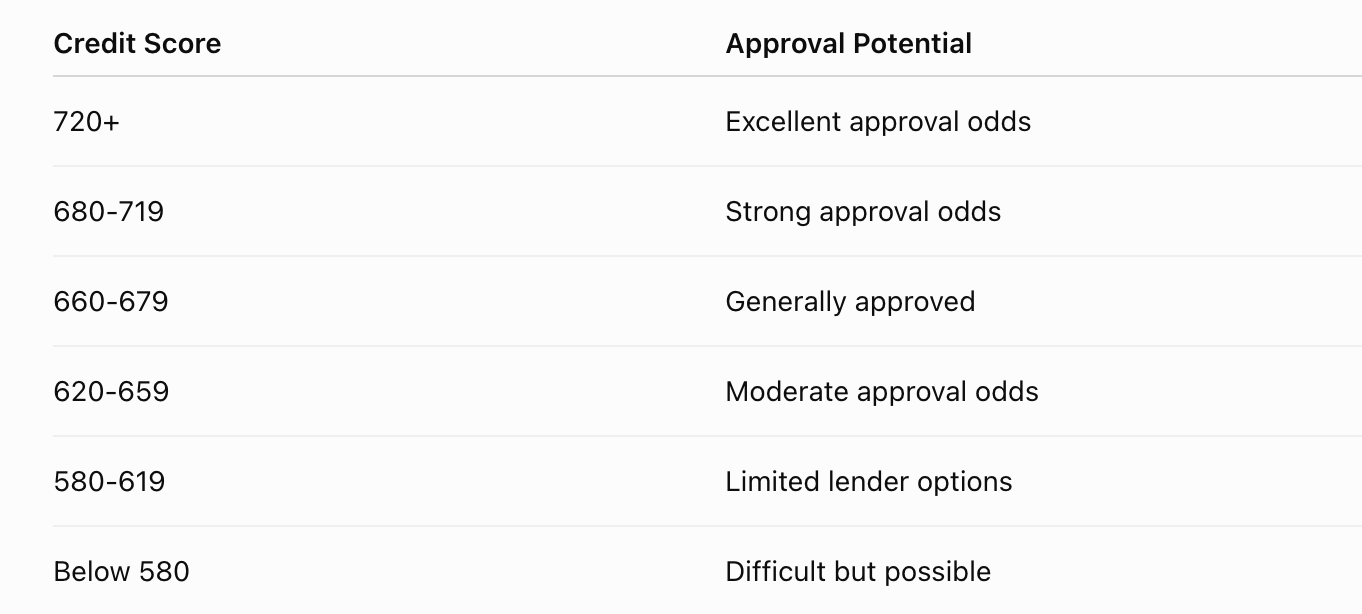
Online lenders advertise approvals below 600, but the loan terms often become less favorable.
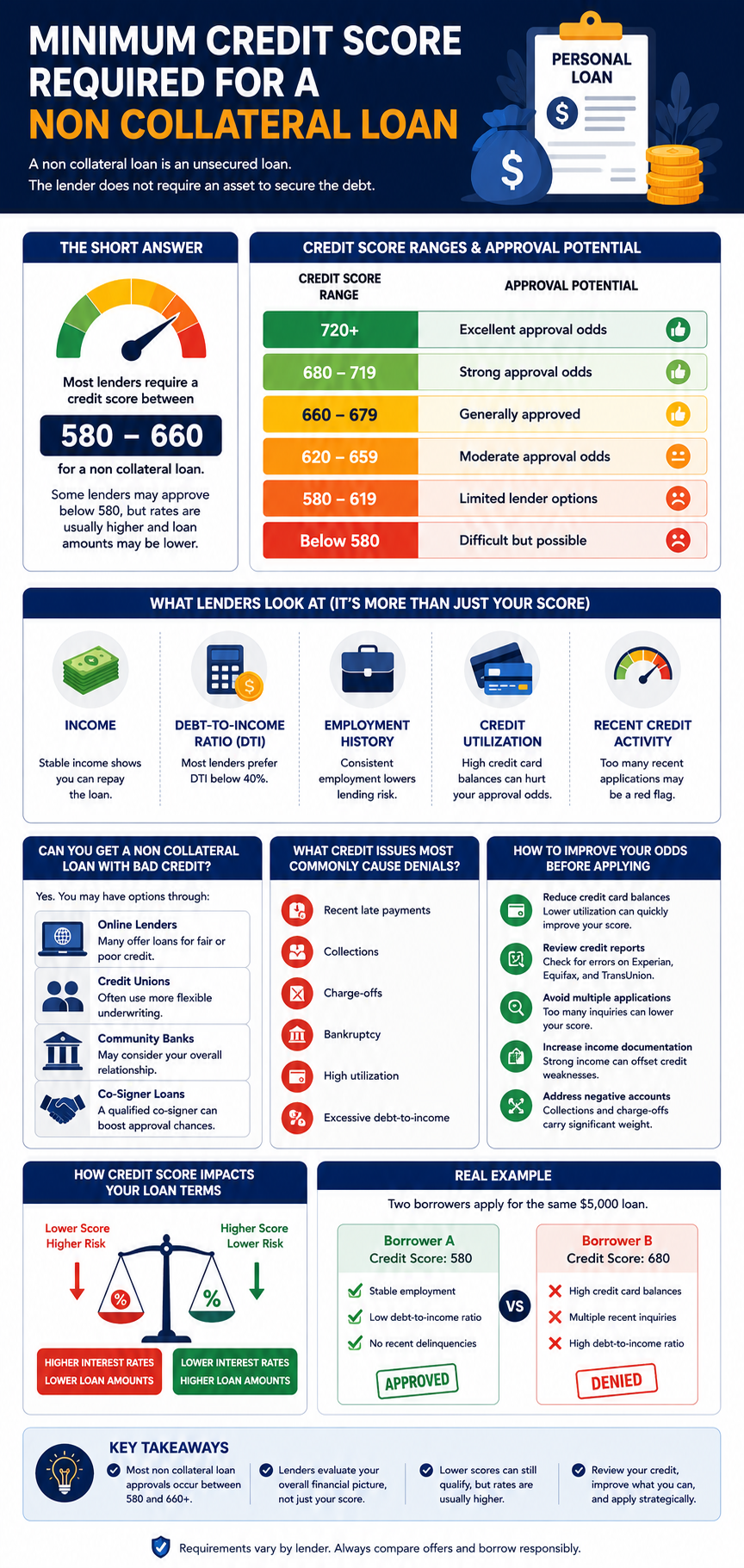
Credit Score Tiers , Aproval Odds and What Rates Actually Cost You
This chart shows what each score tier means in real numbers. Not just the APR range , but what that rate costs you on a $10,000 three-year loan.
What Your Credit Score Actually Costs You , In Real Dollars
The APR number is abstract. The dollar amount is real.
Here is what a $10,000 non colateral loan at different rates costs over 36 months. Same loan. Same amount. Different score.
What Is a Non Collateral Loan?
A non colateral loan is an unsecured loan.
The lender does not require an asset to back the debt.
If you don't pay, the lender cannot immediately repossess a car or foreclose on a house. They have to sue you to recover the money.
Because of this higher risk, lenders rely heavily on your credit profile to decide both whether to approve and at what rate.
Common types of non colateral loans include:
- Personal loans from banks, credit unions, or online lenders
- Debt consolidation loans
- Medical loans
- Emergency loans
- Home improvement loans (when not secured by the home)
Real Lenders , What They Actually Require in 2026
These are the confirmed minimum credit score requirements and APR ranges from lenders active in 2026, based on NerdWallet and Bankrate data.
| Lender | Min Credit Score | Est. APR Range | Best For |
|---|---|---|---|
| Upstart | None stated | 6.70% – 35.99% | Thin credit files; uses income/education as alternative factors |
| Avant | 560 | 11.69% – 35.99% | Bad credit borrowers who need loan access quickly |
| LendingClub | 600 | 6.53% – 35.99% | Debt consolidation with co-borrower option |
| Prosper | 600 | 7.74% – 35.99% | Peer-to-peer lending for borrowers above 600 |
| SoFi | 660 | 7.99% – 24.99% | Good credit borrowers with stable employment |
| LightStream | 660 | 6.49% – 24.89% | Home improvement and major purchases at low rates |
| Federal Credit Unions | Varies | Capped at 18% | Fair credit borrowers , lowest max rate for non-prime |
| Large Banks | 670+ | 8% – 25% | Existing customers with good credit history at that bank |
Credit Score Is Not the Only Factor , Here Is What Else Matters
Real Example: 580 Score Approved, 680 Score Denied , Same Lender
$5,200/month gross income
DTI: 22% before the loan
No collections or late payments in past 18 months
$4,100/month gross income
DTI: 58% with maxed credit cards
Two recent inquiries from other loan applications
What Most Borrowers Miss: The Credit Repair ROI Before Applying
"Clients come to me after getting a non colateral loan at 31% APR and ask if credit repair can help them now. The answer is yes, but the bigger opportunity was six months before. If they had come to us then, we likely could have moved their score from 590 to 640 through utilization reduction and dispute wins. The same lender who approved them at 31% would have offered 19% at 640. On a $15,000 loan over five years, that's over $5,000 in savings. Credit repair before a loan application is one of the most financially impactful things a borrower can do. The question isn't whether the score can be improved. The question is whether you do it before or after the expensive aproval."
The math on waiting three to six months to improve before applying:
- Utilization reduction alone , paying credit cards to under 10% before the statement closes can add 20-40 score points in 30 days.
- One dispute win on an inaccurate collection , can add 20-50 points in 30-90 days.
- Combined effect on a $15,000 five-year loan , moving from 585 to 640 (from 30% APR to 22% APR) saves approximately $3,200 in interest. Moving from 585 to 680 (from 30% APR to 14% APR) saves over $7,000.
Understanding exactly how credit utilization affects your score , and why the statement close date matters more than the payment date , gives borrowers the precise timing needed to maximize score improvement before a loan application.
Joe Mahlow's team at ASAP Credit Repair reviews all three bureau reports and identifies every factor currently suppressing the score , before you apply. Knowing what can be improved in 30 to 90 days may mean the difference between a 28% APR and a 16% APR on the same loan amount.
Get a Free Pre-Loan Credit Review →How to Improve Your Chances Before Applying
As Experian confirms, credit score doesn't tell the full story , lenders evaluate the complete financial picture. That means improving multiple factors simultaneously produces the strongest application profile.
- Pay down credit card balances. Get every card to under 10% of its limit before the statement closes. This produces score improvement within 30 days. Even getting from 80% utilization to 30% on two cards can add 25-40 score points. The guide on improving a credit score from the 593 range maps the exact point gains from each action.
- Dispute reporting errors. Pull all three bureau reports at AnnualCreditReport.com before applying. Any collection with a wrong date, wrong balance, or unverifiable ownership is a dispute opportunity. A successful dispute can remove 20-70 points of suppression in 30-90 days.
- Calculate your DTI before the lender does. Add up all monthly minimum debt payments. Divide by gross monthly income. If DTI is above 40%, pay down installment or revolving balances before applying. A 680 score with 52% DTI may be less fundable than a 620 score with 28% DTI.
- Avoid new credit applications. Each hard inquiry costs 5-10 score points. Multiple recent applications signal financial distress to lenders. Don't apply for new credit cards or other loans in the 90 days before the personal loan application.
- Pre-qualifiy before applying. Most online lenders offer pre-qualification using a soft inquiry , no score impact. Pre-qualify with multiple lenders to compare rates before any hard inquiry is triggered.
As Bankrate's 2026 personal loan rate data confirms, a prime borrower with an excellent score (740+) might land an APR near 6%, while a subprime borrower with a poor score (under 580) will likely see APRs up to 36% , the legal maximum for most traditional lenders. That 30-point APR spread is the financial cost of the credit score gap.
Decision Framework , Apply Now or Improve First?
Related Questions
Why was my personal loan denied with a good credit score?
Credit score is not the only approval factor. A 700 score with 55% DTI (because of maxed credit cards), multiple recent inquiries from other applications, or inability to document income can produce a denial even with a good score. Lenders evaluate the complete financial picture. When a denial happens, request the specific denial reason in writing , lenders are required to provide it under the Equal Credit Opportunity Act. The reason identifies which factor to address before reapplying.
Does getting a personal loan hurt my credit score?
The formal application creates a hard inquiry, which typically reduces the score by 5-10 points temporarily. If approved, the new loan adds a new account (which may briefly lower average account age) and increases total debt. Over time, consistent on-time payments on the personal loan build positive payment history and improve the score. The net effect over 12-24 months of on-time payments is typically positive. Pre-qualifying with a soft inquiry does not affect the score at all.
Can credit repair help me qualifiy for a better personal loan rate?
Yes , specifically when the credit report contains inaccurate information, unverifiable collection accounts, or high credit card balances. Removing one inaccurate collection can add 20-50 points. Reducing credit card utilization from 80% to under 10% can add another 20-40 points. Combined, these changes often move a borrower from one APR tier to a significantly better one. The article on why score improvement depends on the right factors explains what actually moves scores and what doesn't.
- Most non colateral loan approvals start at 560-600 with online lenders; prime rates require 720+
- The difference between a 580 score loan and a 740 score loan on $10,000 over 36 months can exceed $2,200 in extra interest
- Credit score is the gate , DTI, income, and employment determine what rate you receive once through it
- Federal credit unions cap rates at 18% , one of the best options for fair-credit borrowers who qualifiy for membership
- Utilization reduction can produce 20-40 score points within 30 days , often the fastest pre-loan improvement available
- Pre-qualifying with multiple lenders (soft inquiry, no score impact) is always the first step before a formal application
- The national average personal loan rate as of June 2026 is 12.28% , borrowers above 680 are likely to beat that average
Joe Mahlow's team reviews all three bureau reports and identifies every factor currently suppressing the score , inaccurate collections, high utilization, wrong reporting dates. The free review shows exactly what can be improved in 30 to 90 days before a formal loan application, and what those improvements mean in real dollar terms on the loan you are considering.
Get My Free Credit Review → CROA Registered | 20 Years in Business | Free, No Obligation-
Improving a 593 Credit Score: Steps to Reach 650 Faster Moving from the 580-600 range to 640-660 is the single most impactful credit action for most personal loan applicants , it's the range that opens most online lenders at significantly better rates. This covers the exact month-by-month plan: utilization reduction in month one (fastest), dispute wins in months two and three, and positive history building through month 12. The specific point estimates for each action type give borrowers a concrete improvement timeline before applying for a non colateral loan.
-
Collection Removed But Score Didn't Increase? Here's Why Borrowers who are preparing for a loan application sometimes remove a collection account and find the score barely moves. This explains every reason a removed collection produces minimal score movement and identifies what to address next: utilization, remaining late payments, charge-offs, and thin credit files. Understanding why the score didn't move after credit repair work helps borrowers identify the right remaining actions before the loan application date.
-
Can a Debt Collection Agency Charge Interest? What the Law Says Borrowers preparing for a non colateral loan often have collection accounts with balances that have grown significantly from the original amount. This covers when that interest is legally allowed and when it isn't , and more importantly, whether the interest was calculated correctly at the right rate from the right start date. Knowing whether a collection balance is inflated helps borrowers understand the true debt picture before applying for a consolidation loan or evaluating their overall debt-to-income ratio.