
How rare is a 900 credit score? If not impossible, it's extremely rare.
Most Americans will never see a 900 score, and many cannot reach it at all because the credit score model they use caps below that number. Standard FICO scores top out at 850. Some industry specific FICO models and VantageScore models can go higher, but reaching 900 requires nearly flawless credit behavior over many years.
The bigger surprise is this: a 900 score is not necessary to get the best loan terms. Mortgage lenders, auto lenders, and premium credit card issuers already consider borrowers in elite territory well before perfection. Once you move into exceptional credit ranges, the practical borrowing advantages begin to level off.
After reviewing thousands of consumer files for nearly 20 years, one thing becomes clear. People who obsess over chasing a perfect score often focus on the wrong target. The stronger goal is building a clean, stable credit profile that lenders trust.
Perfect on paper is rare. Highly lendable is much more achievable.
Across personal finance forums, borrowers with scores in the 820 to 850 range regularly report receiving the same rates and approvals as the rare few with near perfect profiles.
That is because lenders care less about perfection and more about consistent low risk behavior shown over time.
People ask me about 900 credit scores more than you would think. Usually it comes from someone who saw a score on a car dealership monitor or a bank app that showed a number above 850. Here is what actually happened in those cases , they saw an industry-specific FICO Auto Score or FICO Bankcard Score, which uses a different scale that goes to 900. The score looked impressive. And it was. But the confusion matters because most people do not know there are dozens of scoring models, each built for a different lending decision. What I tell every client is this: stop chasing a number on a ceiling you cannot see. Chase 760. The financial benefits of every point above 760 are essentially zero for most lending products.
How Rare Is a 900 Credit Score
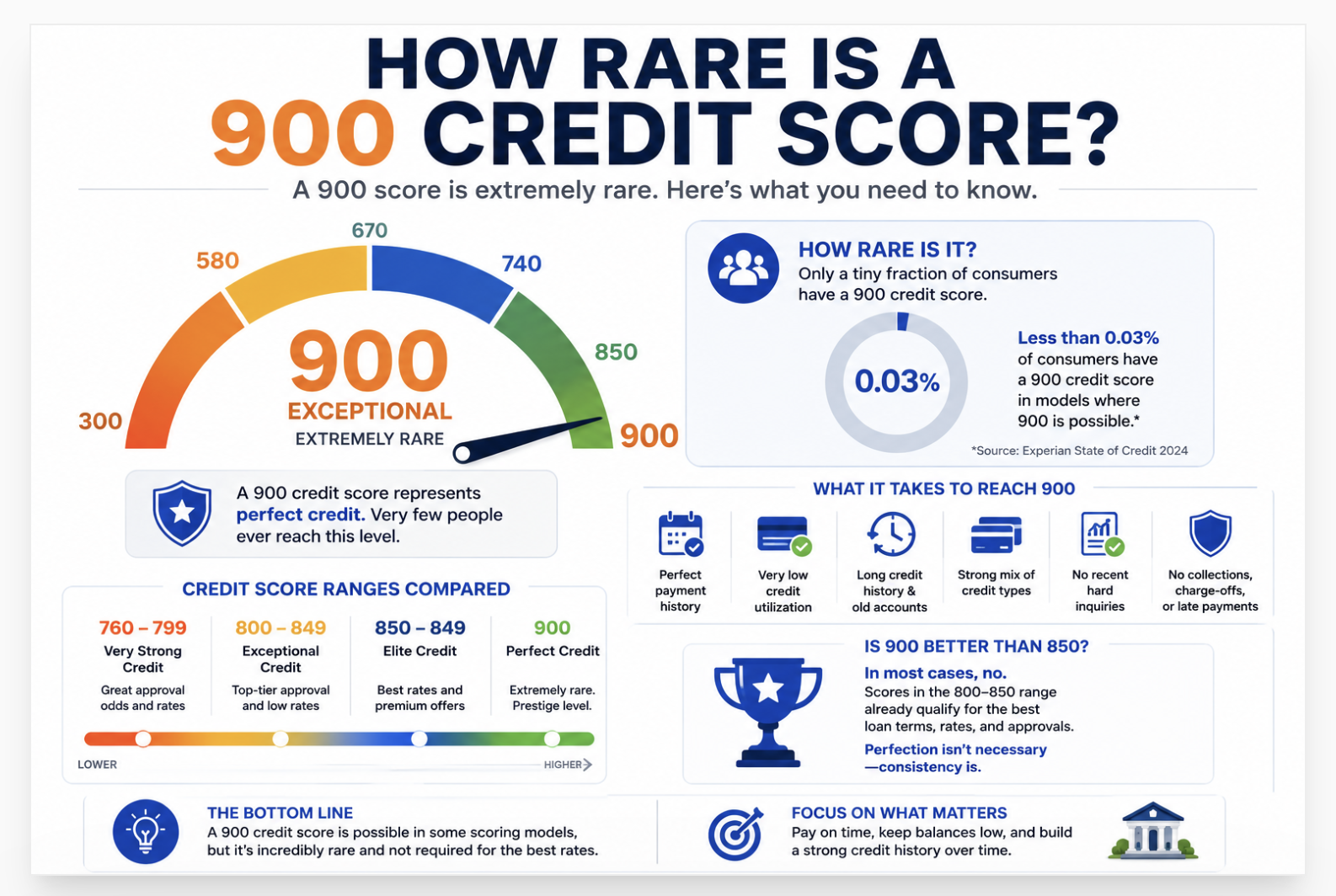
A 900 credit score is impossible on standard FICO and VantageScore, which max at 850. On FICO Auto Score and FICO Bankcard Score (range 250-900), a 900 is theoretically achievable but requires a perfect 850 on the standard scale plus an exceptional history with that specific credit type. Since only 1.76% of consumers reach 850, achieving 900 on a specialty model is a fraction of that group.
Let me start with the honest answer and then go deeper, because there is real nuance here that most articles skip.
On the two scoring systems almost every lender uses, FICO and VantageScore, the highest score is 850. Period. A 900 on those models is not possible the way 901 meters is not possible in a 100-meter race. The scale stops at 850.
Where 900 does exist is in the world of industry-specific FICO scores. FICO Auto Score and FICO Bankcard Score use a range of 250 to 900. These are the scores auto lenders and credit card issuers sometimes pull instead of the standard FICO 8. A borrower who scores a perfect 850 on the standard model and carries an outstanding history of on-time car loan payments can theoretically score in the 870-900 range on the FICO Auto Score. The same dynamic applies for the Bankcard Score , a borrower with a perfect standard score and a clean, deep credit card history can hit the 900 ceiling.
As myFICO's official FICO score versions guide confirms, industry-specific FICO scores range from 250-900 and carry a specialty overlay on top of the standard score. Higher scores still equate to lower risk on those models , but a 900 on FICO Bankcard Score does not unlock different lender pricing than an 870 does, or even an 830 for that matter.
Score Models That Go Above 850
| Scoring Model | Scale Range | Status | Used By |
|---|---|---|---|
| FICO Score 8, 9, 10 | 300-850 | Active , standard | Most credit cards, personal loans, general lending |
| VantageScore 3.0 and 4.0 | 300-850 | Active , standard | Free monitoring apps, some lenders, alternative scoring |
| FICO Auto Score (all versions) | 250-900 | Active , specialty | Auto lenders, dealership financing desks |
| FICO Bankcard Score (all versions) | 250-900 | Active , specialty | Credit card issuers |
| VantageScore 1.0 and 2.0 | 501-990 | Retired | No longer in use. Old loan applications may reference these. |
| FICO Score 2, 4, 5 (mortgage versions) | 300-850 | Active , mortgage specific | Mortgage lenders pull these three in a tri-merge |
Why FICO Auto and Bankcard Scores Go to 900
The reason industry-specific FICO scores extend to 900 is not arbitrary. They apply a specialty overlay on top of the standard FICO score. The overlay adds or subtracts up to 50 points based on the borrower's history with that specific type of credit.
A borrower with a perfect standard FICO of 850 who has also made every car payment on time for the last 7 years and carries no derogatory auto history can receive an additional overlay of 25-50 points from the FICO Auto model. That pushes the score into the 875-900 range. The overlay works in both directions , someone with a perfect 850 base score but a missed car payment 3 years ago may score only 820-840 on the Auto model.
The practical implication is that a 900 on FICO Auto Score requires two achievements simultaneously: a near-perfect standard credit profile and a near-perfect history with the specific product type. The combination is extremely rare. myFICO forum data from users who track their scores across all models shows that even borrowers with standard FICO scores in the 840-850 range typically see FICO Auto and Bankcard scores in the 880-900 range , getting exactly 900 on either model requires every available positive signal in that specific category to align.
A 900 credit score on standard FICO or VantageScore does not exist. The scale stops at 850. On FICO Auto Score and FICO Bankcard Score (250-900), a 900 is theoretically achievable for borrowers with perfect standard FICO scores and deep specialty histories in auto or bankcard credit. Only 1.76% of consumers reach 850 on the standard scale. The 900 group on specialty models is a fraction of that , likely fewer than one in a thousand consumers at any given time.
What It Actually Takes to Hit 850 , The Floor for a Possible 900
Since 900 on a specialty model requires 850 on the standard scale as a starting point, understanding what it takes to hit 850 is step one.
Based on Experian's perfect credit score data, people with 850 FICO scores share a consistent profile. Average age of accounts above 11 years. No missed payments anywhere in the file. Credit card utilization in the low single digits , typically below 5%. A mix of revolving accounts (credit cards) and installment accounts (mortgages, auto loans). Zero collections, charge-offs, or derogatory marks of any kind. And minimal new account activity in the past 12 months.
That profile takes time. Not skill , time. The 15% of your FICO score tied to credit history length cannot be rushed. An 850 score from someone with a 2-year-old credit file is not possible. The people at 850 typically have active accounts stretching back 10-20 years or more, all clean.
Here is what the perfect-score profile looks like in concrete numbers, based on Experian's high achiever data:
| Profile Factor | Average Among 850-Score Holders | Why It Matters |
|---|---|---|
| Number of accounts | 6-7 open accounts | More accounts show diverse credit management without overextension |
| Oldest account age | 25+ years | Length of credit history is 15% of FICO score |
| Average account age | 11+ years | Newer accounts drag this down. Avoiding unnecessary applications protects it. |
| Credit utilization | Below 5% | Amounts owed is 30% of FICO. Near-zero utilization at this level. |
| Late payments | Zero in file | Payment history is 35% of FICO. One late payment prevents 850. |
| Hard inquiries (last 12 months) | 0-1 | Each inquiry costs 5-10 points temporarily. 850 holders rarely apply for new credit. |
| Credit mix | Both revolving and installment | Having both types accounts for 10% of FICO score |
For a 900 on FICO Auto Score, add one more requirement on top of all of the above: a long, active history of on-time auto loan payments with no derogatory auto-related marks. The specialty overlay looks specifically at how you have managed that particular type of credit.
Does a 900 Credit Score Matter Financially
No. A 900 credit score on a specialty model produces no additional financial benefit beyond what a 760-800 standard score already provides. Lender pricing tiers for mortgages, auto loans, and credit cards peak at 760-800 for most products. Above that tier, the exact score changes nothing in terms of rate or approval odds. The financial return on improving a score from 660 to 760 is enormous. The return from 800 to 900 is effectively zero.
This is the honest part I want to make sure lands. People spend mental energy chasing higher and higher scores past the point where it actually changes anything in their financial life.
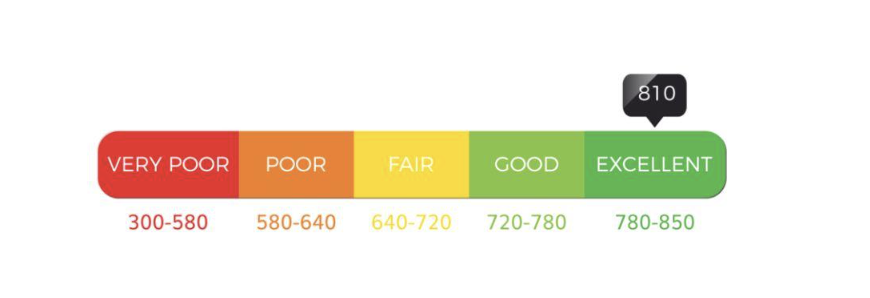
The score that changes your life is the one that moves you from one lender pricing tier to a better one. Every tier crossing below 760 produces real, measurable financial outcomes. A 580 to 620 crossing opens conventional mortgages. A 620 to 680 crossing drops your mortgage rate by roughly 0.8 percentage points. A 680 to 740 crossing drops it by another 0.6 or so. A 740 to 780 crossing saves maybe 0.2 more points. Above 780, the line is essentially flat.
At 800, you receive the same rate offers as an 850 borrower. A 900 on a specialty model is even further from any meaningful financial threshold. As Bankrate's analysis of perfect credit scores confirms, the practical benefits of a credit score plateau around 760-780. Beyond that point, chasing a higher score is a personal achievement rather than a financial strategy.
Where this matters for ASAP Credit Repair clients is in priority setting. Someone at 640 who spends their energy asking about 900 scores is asking the wrong question. The question that changes their financial situation is what it takes to get from 640 to 720. That crossing saves real money on every loan product they use. Our detailed breakdown of how a 796 credit score works and what it gets you covers the specific rate benefits at the near-perfect tier and confirms that the difference between 796 and 850 is essentially nothing in practical lending terms.
How to Reach the Near-Perfect Range
Reaching 800 or above , the tier where every lending product prices at its best , does not require perfection in every category. It requires consistency in the highest-weight factors over a long enough period.
The path for most borrowers with clean but not perfect files involves five actions, in this order of impact.
Pay every bill on time, every month, without exception. Set up autopay for the minimum on every account. One 30-day late payment at an 800-level score costs 50-80 points and resets the clock on reaching that level again. Payment history at 35% of the FICO score is the highest-impact category and the one most completely within your control.
Reduce credit card utilization below 5% on every card, not just on average. FICO looks at individual card utilization as well as overall. One card above 30% utility can prevent an 800 score even when all other cards show zero balance. Pay before the statement close date, not the due date , the balance that appears on your statement is what the bureau receives.
Keep old accounts open. Closing a paid-off card removes that card's available credit from your utilization calculation and reduces your average account age. Both hurt the score. A zero-balance card with no annual fee costs nothing to maintain and helps two score factors simultaneously.
Avoid unnecessary applications. Each hard inquiry costs 5-10 points and triggers the new credit factor. At the 760-800 range, the perfect file you want to maintain becomes harder to protect with frequent applications. Apply only when you genuinely need the credit and are prepared to be approved.
Let time do its work. The 15% that credit history length controls cannot be manufactured. An account opened today adds to your file, but it reduces your average account age for the next several years before it helps it. The borrowers with 850 scores have credit histories that span decades. Consistent positive behavior over years produces what no credit hack can replicate.
Reviewing and cleaning your credit file before each major lending decision is the highest-return action available. Inaccurate entries on your report , wrong late payment dates, incorrect balances, accounts that are not yours , suppress your score below where your actual behavior would place it. Our guide on how to clean your credit report covers the simultaneous three-bureau dispute process that removes inaccurate entries across all bureaus within the same 30-day investigation window.
For borrowers who want a complete picture of how each credit behavior affects each score factor, our breakdown of the 10 best ways to build credit fast ranks each action by speed and score impact with specific point gain ranges from client case tracking.
How rare is a 900 credit score?
On standard FICO and VantageScore, a 900 is impossible , the maximum is 850. Only 1.76% of US consumers hold a perfect 850 as of March 2025. On specialty models like FICO Auto Score and FICO Bankcard Score (range 250-900), a 900 is theoretically achievable but requires both a perfect 850 on the standard scale and an exceptional specialty credit history. The population reaching 900 on any scoring model is likely below 0.3% of all consumers with credit files at any given time.
Can you have a credit score over 850?
Not on standard FICO or VantageScore 3.0 and 4.0, both of which cap at 850. You can exceed 850 on FICO Auto Score and FICO Bankcard Score, which use a 250-900 range. Old VantageScore versions 1.0 and 2.0 once used a 501-990 scale but both are retired. For all practical lending purposes, 850 is the ceiling. Any score above 850 a borrower sees on their file comes from a specialty or alternative scoring model, not the standard consumer score.
Is a 900 credit score better than 850 for loans?
No. Lender pricing tiers for mortgages, auto loans, and credit cards peak well below 850 , typically around 760-800 depending on the lender. A 900 on a specialty model falls outside the standard scoring range and does not correspond to a separate pricing tier at any mainstream lender. Whether a borrower scores 800, 850, or registers 900 on a specialty model, the loan rates and approval odds from most lenders are identical. The financial return on improving a score from 760 to 900 is effectively zero.
What percent of people have a 900 credit score?
On standard FICO and VantageScore, zero percent , because 900 exceeds the maximum scale. On FICO Auto Score and FICO Bankcard Score, an estimated fraction of the 1.76% of consumers who hold a perfect 850 standard score also reach 900 on those specialty models. That fraction is likely between 0.1% and 0.3% of all US consumers with credit files, based on myFICO forum data from borrowers tracking multi-model scores. No public data source publishes a specific percentage for 900 on specialty models.
Chasing 900 From 640 Is the Wrong Race
The score that changes your financial outcomes is the one that crosses you into the next lending tier. Inaccurate entries on your Equifax, Experian, or TransUnion report may be holding you below that tier right now. A free 3-bureau audit shows every entry suppressing your score before your next application.
Get My Free 3-Bureau Audit → Secure · 2 minutes · No credit card required-
Factors Lenders Check Beyond the Credit Score A perfect score does not guarantee a perfect loan outcome. Lenders weigh six factors beyond the number itself , DTI, reserves, employment history, property condition, loan-to-value, and the specific FICO model they pull. This covers what each factor means for approval odds and rate pricing, and which ones move fastest for borrowers preparing for a mortgage or auto loan application.
-
Credit Score Range , What Each Tier Means for Borrowing The 300-850 FICO scale is divided into tiers that each produce different borrowing outcomes. This covers every tier from Deep Subprime through Exceptional, what financial products open at each threshold, where lender pricing tiers peak, and why the difference between 700 and 760 matters far more to your wallet than the difference between 800 and 850.
-
647 Credit Score Guide A 647 score sits in the Fair tier , the range where the financial cost of a lower score is most significant relative to the effort required to improve it. This covers the specific actions that move a 647 into the Good tier where lender pricing changes meaningfully, and the 60 to 90 day timeline most borrowers at this level can realistically expect for that improvement.