

A Houston car accidents impact your credit score through financial obligations that continue long after the collision. According to the Texas Department of Transportation, Houston records tens of thousands of traffic crashes annually, exposing drivers to medical expenses, lost wages, vehicle repair costs, and insurance disputes. While an accident does not directly affect a FICO Score, missed loan payments, increased credit card balances, and eligible collection accounts can create lasting financial consequences.
Language barriers can make these problems worse, particularly in Houston's multilingual communities. Drivers with limited English proficiency may struggle to understand insurance policy exclusions, medical bills, settlement documents, or requests for supporting evidence. Miscommunication can delay claims, lead to incomplete documentation, and make it harder to challenge an insurer's assessment. An incomplete or misunderstood claim can result in a lower settlement offer or unreimbursed expenses, although language barriers alone do not determine compensation.
These financial gaps matter because insurance settlements do not automatically cover every expense following a crash. When medical bills remain unpaid or borrowers fall behind on existing obligations, the resulting financial pressure can affect creditworthiness.
This guide explains how Houston car accidents can affect credit scores, how language barriers complicate insurance claims, and what drivers can do to protect their finances while resolving accident-related expenses.
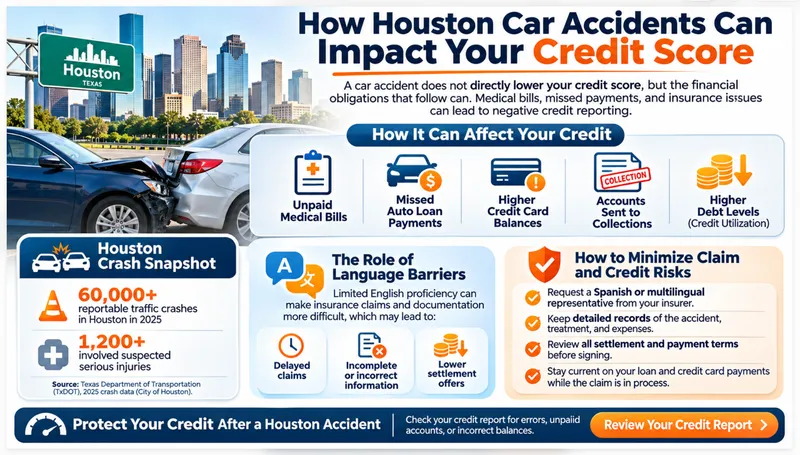
How Houston Car Accidents Impact Your Credit Score
Houston car accidents impact your credit score when medical expenses, lost income, and unpaid auto loans create financial problems after a collision. According to 2025 crash data from the Texas Department of Transportation (TxDOT), the City of Houston recorded 60,317 reportable traffic crashes, including 1,249 with suspected serious injuries. Each one leaves a driver facing treatment, vehicle costs, and a gap in income.
Here is the part most people miss. A car accident itself does not appear on a credit report or directly reduce a FICO Score. Missed auto loan payments, rising credit card balances, and certain collection accounts do.
FICO assigns about 35% of a typical score to payment history and 30% to amounts owed, according to myFICO. Those are general weights, not fixed percentages for every model. They explain why accident-related expenses hit hardest when a household budget stops covering its bills.
How insurance claims, medical bills, and outstanding vehicle loans get handled decides the damage. A totaled car does not cancel its loan, and a settlement is sometimes lower than the balance. This guide shows which accident-related debts reach your credit reports and how to protect your standing after a crash.
- The crash is not a credit event. Insurance claims and accident reports never appear on your credit reports.
- Payments are the main risk. A totaled car does not pause your loan.
- Medical debt follows its own rules. The federal rule was vacated, so bureau policies decide what shows.
- Check your reports. Duplicate collections, wrong balances, and uncredited payments are fixable.
Do Car Accidents Affect Your Credit Score Directly?
A car accident does not directly affect your credit score. However, missed loan payments, increased credit card debt, and certain collection accounts resulting from accident-related expenses affect your credit report and FICO Score. Insurance claims and accident reports are not themselves credit-scoring events.
Here is the quick comparison of what counts and what does not.
| Accident-Related Event | Direct Credit Impact? |
|---|---|
| Being involved in a collision | No |
| Filing an auto insurance claim | No |
| Receiving medical treatment | No |
| Missing an auto loan payment | Yes, once reported late |
| Increasing credit card balances | Yes, through higher utilization |
| An eligible medical collection on a credit report | Yes, when it is reported |
| Receiving a personal injury settlement | No automatic score change |
7 Ways a Houston Car Accident Hurts Your Credit
1. Missed Auto Loan Payments After a Collision
An accident does not suspend your loan contract. You still owe each scheduled payment while the insurance claim is processed.
Payment history is the biggest score factor, so one reported late payment costs more than most other accident-related events.
2. Medical Bills That Become Collection Accounts
Medical billing, unpaid medical debt, and credit reporting are three different things. A bill reaches your credit report only if it goes to collections and the bureaus' policies allow it. The next section covers the rules.
3. Credit Card Balances Used to Cover Emergency Expenses
Deductibles, rental cars, rideshares, and groceries often land on a card. That raises your utilization, the share of your limit you use.
Example (illustrative): A $4,000 balance on a $5,000 limit equals 80% utilization. Amounts owed make up about 30% of a typical FICO Score, per myFICO. Our post on credit utilization and score drops shows how to lower it.
4. Lost Income Leading to Missed Payments
Time away from work means a smaller paycheck. Rent, credit cards, auto loans, and personal loans do not shrink to match it, so payments slip.
5. Remaining Auto Loan Debt After a Total Loss
Insurance pays the actual cash value of your car. If you owe more than that, you still owe the difference, unless gap coverage applies.
6. New Borrowing to Replace a Damaged Vehicle
A replacement car adds a hard inquiry, a new account, and a new monthly payment. According to myFICO, a hard inquiry typically lowers a FICO Score by less than five points. The larger effect is the added debt load, not the inquiry.
7. Incorrect Collection Balances or Payment Statuses
Billing mix-ups after a crash produce real reporting errors: duplicate collections, wrong late payments, wrong balances, and payments never credited. Errors like these are the only part of the damage you challenge directly. See the dispute section below.
Do Medical Bills From a Houston Accident Appear on Your Credit Report?
Yes, when an unpaid medical bill goes to collections and the bureaus' policies allow it to be reported. The treatment itself never appears. A medical expense charged to a credit card is different: it counts as ordinary card debt.
The federal picture changed in 2025. The CFPB finalized a rule to remove medical debt from credit reports, but on July 11, 2025, the U.S. District Court for the Eastern District of Texas vacated it. Federal law does not categorically ban medical debt from your reports.
The major bureaus run their own policies. In a joint 2023 announcement, Equifax, Experian, and TransUnion said paid medical collections are not included, unpaid medical collections wait one year before appearing, and medical collections under $500 are removed. Policies change, so confirm the current terms with each bureau.
Read our guide on how medical debt affects your credit score for the full picture. Hospitals and providers in the Houston area bill through insurers, liens, and payment plans, so ask for an itemized bill before you assume you owe the amount in collections.
What Happens to Your Auto Loan After a Total-Loss Accident?
Your loan stays active after a total loss. The insurer pays the car's actual cash value, usually to the lender first, and you owe any remaining balance. GAP coverage, if you have it, covers some or all of that difference under its contract terms.
The CFPB explains that GAP insurance is meant to pay the difference between what you owe on the loan and what your insurer pays, and that terms and exclusions vary. Here is an illustrative scenario.
| Illustrative Total-Loss Scenario | Amount |
|---|---|
| Remaining auto loan | $24,000 |
| Insurance settlement | $19,000 |
| Shortfall | $5,000 |
A $5,000 shortfall is not forgiven automatically. Whether GAP pays depends on your contract and your claim. If you skip the loan payments while you wait, the late payments report.
Keep paying, or contact the lender early about your options. Our guide on fixing credit issues before you apply for a loan helps when you shop for a replacement car.
Does an Insurance Settlement Repair Credit Damage?
No. A settlement is money, not a credit event, so it does not change your score on its own. It pays down medical bills, loans, and balances if you apply it that way.
Accurate negative information stays for its reporting period, even after a payout. The FTC says most negative items stay on a report for seven years. A settlement is also not something a bureau reports.
Texas personal injury law and federal credit reporting law are separate systems, and the credit rules are the same in Houston and across Harris County. An injury attorney pursues compensation for your claim. That attorney does not remove accurate late payments or collections from your credit reports.
Ayuda en Español: Your Injury Claim and Your Credit Report Are Two Different Jobs
Many Houston families need both legal and credit guidance in Spanish after a crash. Keep the two jobs apart: one protects your injury claim, the other protects your credit report.
Si hablas español y sufriste un choque en Houston, busca Abogados especializados en lesiones personales y accidentes en Houston para tu reclamo. The Ben Dominguez Law Firm, a Houston personal injury practice, publishes its website in Spanish.
Para tu crédito, revisa tu informe: saldos, pagos atrasados y cuentas en cobranza. Pull your free reports at AnnualCreditReport.com.
How to Protect Your Credit After a Houston Accident
- Pull your credit reports. Get all three at AnnualCreditReport.com and note every open account.
- Keep your minimum payments current. Set up autopay for the loans and cards you cannot afford to miss.
- Call lenders early. Ask about hardship options before you miss a payment, not after.
- Ask for itemized medical bills. Compare them with your insurance explanation of benefits.
- Use cards carefully. Keep utilization low where possible, and avoid new accounts you do not need.
- Confirm your total-loss numbers. Know your loan balance, the insurer's value, and your gap coverage.
- Keep every document. Save claim letters, receipts, bank records, and billing statements.
If your finances are already strained, review your options for credit repair in Houston.
What if Accident-Related Debt Is Reported Incorrectly?
Dispute it. Under the Fair Credit Reporting Act, you have the right to dispute inaccurate information with both the credit bureau and the company that reported it. The CFPB walks through the steps on its dispute page, and our guide covers inaccurate credit report information in detail.
- ✓Duplicate collections: show the account histories and collection notices.
- ✓Wrong late payment: send payment receipts and bank records.
- ✓Wrong balance: attach statements and payoff confirmation.
- ✓Payment not credited: include the confirmation and the date it cleared.
Accurate negative information stays. A dispute fixes errors, not true entries.
Did a Houston Car Accident Lead to Credit Report Problems?
Medical bills, missed payments, and insurance delays create financial challenges long after a collision. If your credit report contains an incorrect balance, payment status, or collection account, reviewing the information is the first step toward resolving the problem.
Review Your Credit Report → ASAP Credit Repair USA helps consumers identify credit reporting errors and understand their dispute options.Frequently Asked Questions About Houston Car Accidents and Credit
Does a car accident affect your credit score?
No, the accident itself does not. A collision and an insurance claim never appear on your credit reports, but the bills that follow do. Missed auto loan payments, higher card balances, and unpaid medical bills sent to collections lower your score, so check each of those first on all three bureau reports.
Do medical bills from a car accident hurt your credit?
Yes, when an unpaid bill goes to collections and the bureaus' policies allow it on your report. In their 2023 announcement, the bureaus said paid medical collections are excluded, unpaid ones wait a year, and those under $500 are removed. Medical expenses on a credit card count as ordinary card debt.
Does filing an insurance claim affect your FICO Score?
No. Credit reports list loans, cards, and collections, not insurance claims, so filing one leaves your FICO Score unchanged. Your premium or a later insurer review is a separate matter from your credit file, which means you should keep the claim and your credit questions apart, and watch your payment dates instead.
What happens to your car loan if your vehicle is totaled?
The loan stays active. Your insurer pays the car's actual cash value, usually to the lender first, and you owe any balance left over. GAP coverage, if you bought it, pays some or all of that gap under its terms, so keep paying until the lender confirms in writing that the loan is closed.
Is it okay to stop making car payments while waiting for insurance?
No. Your loan contract keeps running while the claim is processed, so a missed payment reports as late. Call your lender early to ask about hardship options, because the insurer's delay does not pause your obligation to make each scheduled payment until the loan is paid off, or closed in writing.
Does a personal injury settlement improve your credit score?
Not automatically, because a settlement is not a credit event and your score does not change when you receive it. The money helps indirectly when you pay down balances, catch up on loans, or settle bills before collections. Accurate negative items still follow their normal reporting period, so plan your payoff order.
How long do accident-related late payments stay on your credit report?
The FTC says most negative information, including late payments and collections, stays on your credit report for seven years. Newer late payments hurt more than older ones, and their effect fades as you pay on time. An accurate late payment stays for its full period unless the creditor corrects it.
Is it possible to dispute medical debt from a car accident?
Yes. If the balance, status, or ownership is wrong, dispute it with both the credit bureau and the collector, and attach evidence such as itemized bills and insurance explanations of benefits. A dispute fixes inaccurate reporting, but it does not remove a debt you owe that is reported correctly and legally.
The crash is over, but the paperwork is not. Check your reports early, keep your payments current, and fix the errors you find.
- Texas Department of Transportation — Crashes and Injuries, Cities and Towns, 2025 (reports processed as of April 7, 2026)
- CFPB — Medical information rule (vacated July 11, 2025)
- CFPB — What is Guaranteed Asset Protection (GAP) insurance?
- CFPB — How do I dispute an error on my credit report?
- Equifax, Experian, TransUnion — Joint announcement on medical collections reporting (April 2023)
- myFICO — What is in your credit score
- myFICO — Do credit inquiries lower your FICO Score?
- Federal Trade Commission — Fixing Your Credit FAQs
- AnnualCreditReport.com — Free credit reports