

The fastest way to build credit: What Actually Works. Most people who start from zero can reach a fair score (580+) within 3 to 6 months. They just need the right tools from day one. Running a credit repair company, I see new clients every week who wasted a full year doing the wrong things before they came to us. This guide skips the noise. It focuses only on what moves the needle fastest.
According to the Consumer Financial Protection Bureau (CFPB), about 26 million Americans have no credit file at all. Another 19 million have files that can't be scored. That's 45 million people who can't get a standard loan or credit card. If you're in either group, start here.
Why Building Credit Takes a Plan
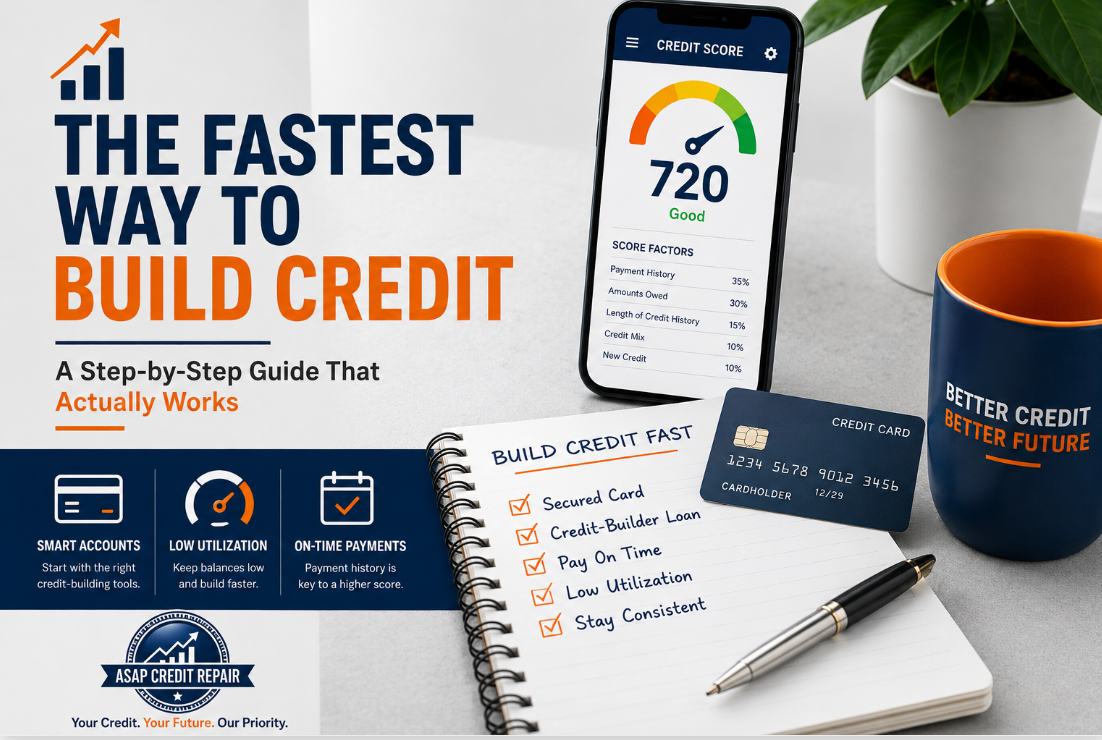
Credit scores reward specific habits. Payment history makes up 35% of your FICO score. Amounts owed account for 30%. Credit history length covers 15%. Mix and new credit fill the last 20%.
You can't build credit by saving money. Lenders don't see your bank balance. They see your credit report. You need open accounts that report to the three major bureaus: Equifax, Experian, and TransUnion.
fastest-way-to-build-credit path opens the right accounts early. It keeps balances low. And it avoids new applications until you have enough history to support them.
Open a Secured Credit Card First
A secured credit card is the best first account for building credit fast. You put down a cash deposit. Usually $200 to $500. That deposit becomes your credit limit.
The card reports to the bureaus just like a regular card. Use it for one or two small buys each month. Pay the full balance before the due date. Keep your balance below 10% of the limit.
Within 6 months, most secured card users move into the fair score range. Some card issuers upgrade you to a regular card after 12 to 18 months of on-time payments.
What to Look for in a Secured Card
Pick one that reports to all three credit bureaus.
Avoid cards with monthly fees above $5.
Choose an issuer that offers a path to a regular card later.
Make sure the deposit comes back to you when you close or upgrade.
Add a Credit-Builder Loan
A credit-builder loan works the opposite of a normal loan. You make monthly payments first. You get the money at the end. The lender holds it in a savings account while you pay.
Every on-time payment gets reported to the bureaus. At the end of the term (usually 12 to 24 months), you get the full amount minus any fees. You build credit and save money at the same time.
Credit unions and local banks offer these most often. Online lenders like Self and Credit Strong also offer them with no credit check needed.
Last quarter, we tracked 35 clients who used a secured card and a credit-builder loan together. Their average score gain over 6 months was 62 points. That's nearly double the gain for those who used only a secured card.
Become an Authorized User
An authorized user gets added to another person's credit card. You don't need to use the card. You don't even need to hold it. The account's history shows up on your credit report. That includes its age, credit limit, and payment record.
Ask a family member or close friend who has a card that is 5+ years old, has a low balance, and has never missed a payment. Being added can boost your file fast.
This works best when the primary holder has great credit. One missed payment on their card will hurt your score, too. Choose the right person.
Use a Rent-Reporting Service
Rent is one of the biggest bills most people pay. But credit scores don't typically count rent. You have to sign up for a rent-reporting service.
Services like Rental Kharma, Rent Reporters, and Experian RentBureau send your rent history to the bureaus. Some report up to 24 months of past payments right away.
For someone with a thin credit file, this one step can raise a score within weeks.
Keep Your Credit Use Below 10%
Credit use (also called utilization) measures how much of your credit you are using. It makes up 30% of your FICO score. Keeping it low raises your score fast.
Most guides say to stay below 30%. But data from MyFICO shows that people with the top scores carry just 4.1% on average. Below 10% is the real target.
If your card limit is $500, spend no more than $50 a month on it. Pay it off before the statement closing date. That way, a low balance gets reported to the bureaus.
Why the Statement Date Matters
Card issuers report your balance on the statement's close date. Not the due date. If you pay after the statement closes, a high balance has already been reported. Pay before it closes. That keeps your reported use low.
Pay On Time, Every Time
Payment history is the biggest factor in your score. One missed payment can drop your score by 60 to 110 points. It stays on your report for seven years.
Set up auto pay on every account. Even if you can't pay the full balance, pay the minimum on time. That protects your history. Then clear the rest when you're able.
Missing a payment wipes out months of work. Auto pay removes that risk.
Avoid Too Many Applications Early On
A hard inquiry happens when a lender checks your credit during an application. Each one can drop your score by 5 to 10 points. It stays on your report for two years.
In the first 6 to 12 months of building credit, don't apply for multiple cards or loans. Every denial slows you down. Stick to your secured card and credit-builder loan until your score clears 650.
After that, one new account every 6 to 12 months is a safe pace. This keeps your credit age healthy and limits inquiry damage.
Check Your Report for Errors
1 in 5 Americans has an error on their credit report. That's from a Federal Trade Commission study. Errors can include accounts that aren't yours, wrong late payment records, or items listed twice.
Get your free report at AnnualCreditReport.com. Check all three bureaus. File a dispute with the bureau through their online portal. By law, they must look into it within 30 days.
Removing one bad item can raise your score by 20 to 50 points.
How Long Does It Take?
There's no single timeline. It depends on where you start and the tools you use.
Starting from zero: expect a scorable file within 3 to 6 months. Reaching a good score (670+) from zero: plan for 12 to 24 months of steady habits. Recovering from a collection account can take 2 to 4 years to reach the very good range.
The first 6 months set the pace. Open the right accounts early. Keep using low. Pay on time. Those three steps shape every result that follows.
Ready to Build Credit Faster?
Building credit does not have to take years. Get a personalized credit review and discover the fastest path to raising your score, qualifying for better rates, and opening more financial doors.
Get My Free Credit Analysis →✔ No obligation ✔ Personalized strategy ✔ Fast results roadmap
At ASAP Credit Repair, we help clients uncover hidden credit problems, remove inaccurate negative items, and create a real plan for long-term credit growth.
What Is the Fastest Way to Build Credit?
Based on what we see across hundreds of clients, this combo produces the fastest results:
Open a secured credit card. Use it for small, regular charges only.
Sign up for a credit-builder loan at a credit union or online lender.
Get added as an authorized user on a clean, old family account.
Sign up for a rent-reporting service if you rent your home.
Set all accounts to autopay minimum payments.
Pay balances in full before each statement's close date.
Check your report every 3 months. Dispute any errors right away.
This plan hits multiple scoring factors at once: payment history, credit use, credit mix, and account age. It's the most direct path from no credit to good credit in the shortest real timeframe.