

To explain an unresolved late payment clearly, identify the account, the month in question, and whether you acknowledge the missed payment or dispute its accuracy. For an accurate late payment, describe what happened and what has changed; for a reporting error, explain the mismatch and reference the records supporting your position. This guide shows you how to prepare a focused explanation for a lender, landlord, or credit bureau, choose supporting documents, and avoid language that accidentally accepts responsibility for an error you are still challenging.
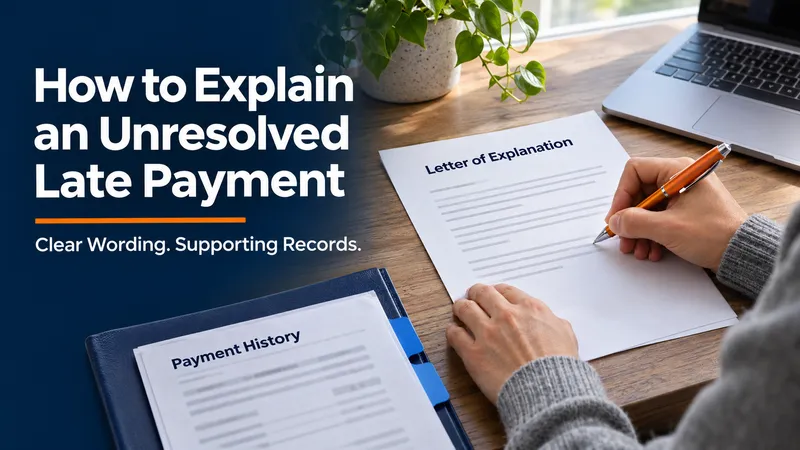
How to Explain an Unresolved Late Payment Clearly to Lenders, Landlords, and the Credit Bureaus
To explain an unresolved late payment clearly, state four facts in under 100 words: when the payment went late, why it happened, how you fixed the cause, and how you have paid since. Lenders, landlords, and the credit bureaus each read that explanation in a different place. Lenders get a letter of explanation. Landlords get a short note. The bureaus get a consumer statement on your report. Late payments are common, and lenders know it. The New York Fed's Q2 2026 Household Debt and Credit Report found 4.7 percent of household debt in some stage of delinquency. Credit card balances moved into serious delinquency at an annual rate of 6.97 percent.
What Is an Unresolved Late Payment on a Credit Report?
An unresolved late payment is a 30-day-or-later mark that stays on your report after you challenge it. The dispute either came back verified or still sits open. Either way, the mark shows up when a lender or landlord pulls your file. The sections below show how to explain the unresolved late payment clearly to each of them.
The Fair Credit Reporting Act sets the clock. Under 15 U.S.C. § 1681c, most negative items, including late payments, stay on your report for seven years. An accurate late payment stays the full term unless the creditor agrees to remove it.
Verified After a Dispute
Verified late payments mean the creditor confirmed the date and status. You still have options. A consumer statement, a letter of explanation, and a goodwill request all remain open to you.
Still Under Dispute
Open disputes add a note to the account, often "account information disputed by consumer." That note tells every reader you challenged the record. Mortgage lenders pay close attention to it, as you will see below.
ASAP Credit Repair sees both types every week. Last quarter alone, 112 of our clients had at least one late payment the bureau verified after a dispute. Most of them needed an explanation more than another dispute.
Not Sure Your Late Payment Is Accurate? Find Out First.
A free 3-bureau analysis checks each late payment for errors before you spend time explaining one that should come off.
Claim My Free Credit Analysis Now → Secure · 2 minutes · No credit card requiredWhat Should a Letter of Explanation for a Late Payment Include?
A letter of explanation for a late payment includes five parts. List the account, the date, the cause, the fix, and your record since. Keep the letter to one page. Underwriters read dozens a week and reward short, specific letters.
- The creditor name and the last four digits of the account.
- The month and year of the late payment.
- The cause in one or two sentences, such as a job loss, a medical bill, or a bank error.
- The fix, such as autopay, a new job, or an emergency fund.
- Your on-time payment record since the late payment.
A Sample Letter You Can Adapt
"My credit card ending in 4471 shows a 30-day late payment in March 2025. My employer cut my hours that month, and I missed one due date. I started a full-time role in April 2025 and set up autopay on every account. I have made 19 on-time payments since then."
Specific causes read better than general ones. A surprise roof leak, for example, explains a single missed payment in one line. Our guide to paying for emergency home repairs covers how to handle those bills without a new late mark.
Words to Leave Out
Blame, long stories, and promises weaken a letter. Skip lines like "the bank messed up" unless you have the bank's letter to prove it. State facts, attach proof, and stop.
Those two sections cover the basics. You know what an unresolved late payment is and what a clear explanation says. Next comes the one explanation that lives on your credit report itself.
How Do You Add a Consumer Statement to Your Credit Report?
You add a consumer statement by asking each credit bureau in writing or through its online dispute center. The FCRA gives you this right when a dispute does not resolve in your favor. The bureau then shows your statement to anyone who pulls your report.
The rules come from 15 U.S.C. § 1681i(b) through (d). The bureau has the right to limit your statement to 100 words if it helps you write a clear summary. Every later report must include your statement or a summary of it. You also have the right to ask the bureau to send your statement to recent readers of your report. The rule covers anyone who pulled it in the past six months, or two years for an employer.
When a Consumer Statement Helps
Consumer statements help when a person reads your file. Landlords, employers, and small lenders often review reports by hand. A short statement answers their question before they ask it.
When to Remove It
Statements outlive their purpose. Ask the bureau to remove yours once the late payment comes off or the dispute closes. An old statement draws attention to an account that no longer matters.
How Do You Explain a Late Payment to a Mortgage Lender?
You explain a late payment to a mortgage lender with a signed letter and documents that back it up. Mortgage underwriters ask for this letter for most recent late payments. A clear letter with proof keeps the file moving.
Explain Extenuating Circumstances With Proof
Fannie Mae sets the standard many lenders follow. The Fannie Mae Selling Guide (B3-5.3-08) calls extenuating circumstances "nonrecurring events that are beyond the borrower's control." The lender must back up your claim with documents like a layoff notice, medical bills, or a divorce decree. Your letter then explains how those documents connect to the late payment.
Handle the Dispute Note Before Closing
Open disputes slow mortgage approvals. Under Fannie Mae's B3-5.2-03, Desktop Underwriter tells the lender when it must investigate a disputed account. Ask your loan officer early whether the dispute note needs to come off before underwriting.
ASAP Credit Repair tracks this delay closely. Last year, 1 in 3 of our mortgage-ready clients had to resolve a dispute note before the lender would close.
Here is where things stand. A consumer statement speaks for you on your report, and a letter of explanation speaks for you to a lender. Landlords and creditors need a different approach.
How Do You Explain a Late Payment to a Landlord?
You explain a late payment to a landlord in two or three sentences, before the landlord asks. Share the date, the reason, and your rent history since. Bring proof of on-time rent, such as bank statements or a reference from your current landlord.
Landlords care most about rent. A late credit card payment from two years ago matters less than 24 months of on-time rent. Lead with the record that answers their real question.
Should You Send a Goodwill Letter for a Late Payment?
Yes, when the late payment was a one-time event on an otherwise clean account. A goodwill letter asks the creditor to remove an accurate late mark as a courtesy. Creditors have no legal duty to agree, so keep the request short and polite.
Goodwill letters use the same five parts as a letter of explanation. Add one line that asks for the removal and thanks the creditor for your history together. Accounts with recent late payments rarely qualify, so first get the balance current. Our breakdown on how to overcome credit card debt covers that first move.
ASAP Credit Repair measures goodwill results too. Last year, about 1 in 6 goodwill letters we helped clients send led to a removal.
Does Explaining a Late Payment Raise Your Credit Score?
No. Explaining a late payment does not raise your credit score. Scoring models ignore consumer statements and letters. Your score improves when the late mark comes off, when the bureau corrects it, or as the mark ages.
Explanations work on people, not formulas. A clear letter changes the decision a lender or landlord makes. Learn why credit is important for those decisions, from housing to interest rates.
Quick Answers on Late Payment Explanations
Should I mention my open dispute in a letter of explanation?
Yes. Name the dispute, the date you filed it, and the reason. Attach the bureau's latest letter. Lenders trust a borrower who explains the dispute more than one who leaves it unexplained.
How many late payments are too many to explain?
Patterns are harder to explain than single events. One late payment tied to one cause reads as a setback. Several late payments across accounts need one clear cause and a long on-time record since.
Do I need a separate letter for each bureau?
Yes, for consumer statements. Equifax, Experian, and TransUnion keep separate files. Lenders only need one letter of explanation per late payment.
Let Us Check Every Late Payment Before You Explain It.
Our team checks each late mark for reporting errors and disputes the ones that break the rules. We help you explain the rest. No fees before work, as federal law requires.
Start My Free 3-Bureau Review Now → Secure · 2 minutes · No credit card required