

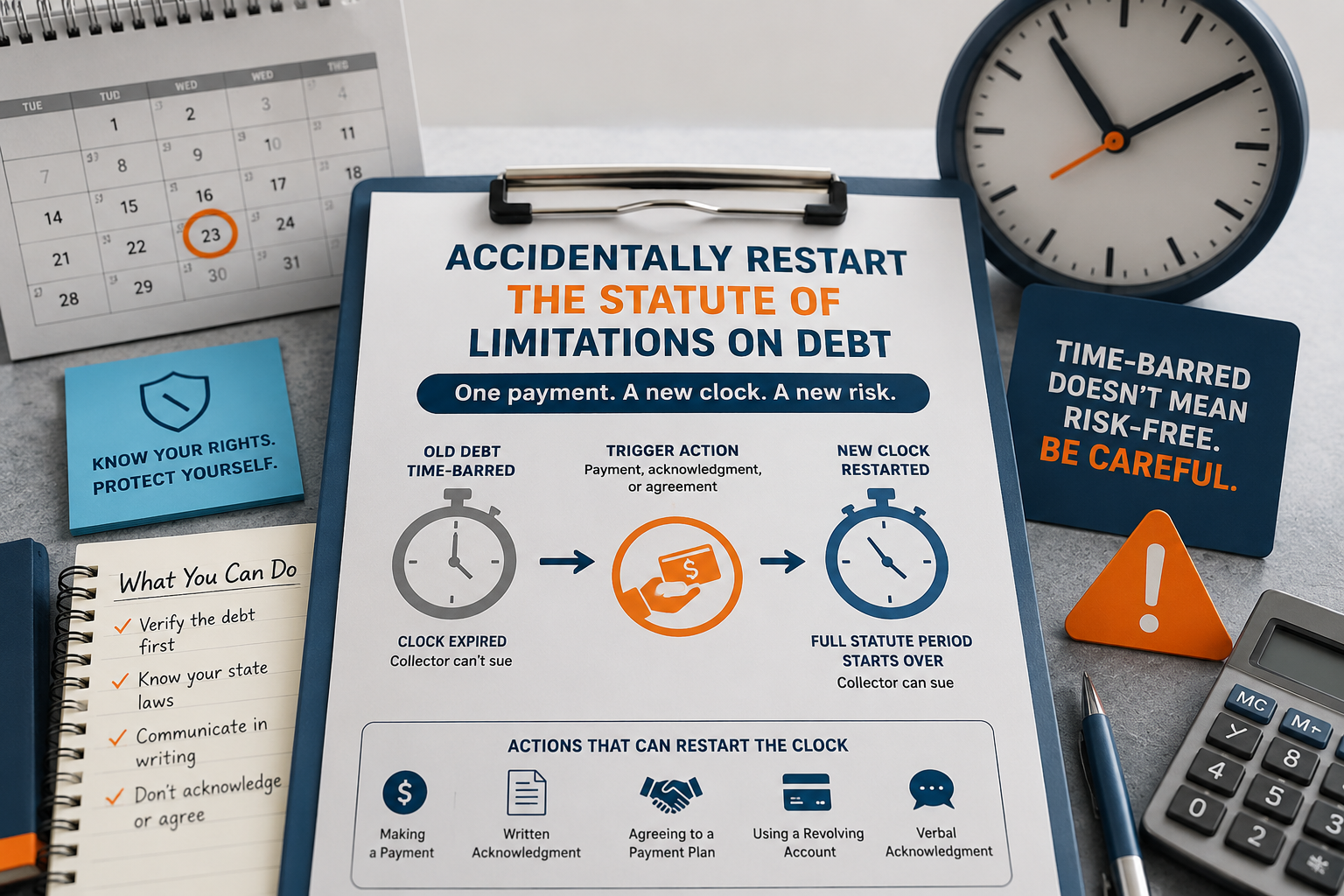
Accidentally Restart Statute of Limitations on Debt? The collector has a fresh window to sue you. The old clock stops. A new one starts from zero, for the full balance, not just the amount you touched. One $10 payment on a five-year-old debt can undo years of legal protection in most states.
I run a credit repair company, and this is one of the most preventable traps I see clients fall into. One case stays with me: a client got a call from a collector about a six-year-old credit card debt. She felt guilty, made a $25 "good faith" payment over the phone, and called me a week later. In her state, that payment restarted the statute from scratch. She went from a debt that couldn't touch her in court to one that could follow her for another six years.
The CFPB confirmed this risk directly in its own research: "Many consumers may find it counterintuitive that making a payment, which they believe ought to have positive consequences for them, may actually have negative consequences." (CFPB, Limits on Collection of Time-Barred Debt). The FTC echoes this: in some states, paying any amount on a time-barred debt, or even promising to pay, revives it completely.
What the Statute of Limitations on Debt Actually Does
The statute of limitations is the legal window a creditor has to sue you for an unpaid debt. Once that window closes, the debt becomes "time-barred." The creditor can still call you and write to you, but they lose their most powerful tool: a lawsuit.
Most states set this window at three to six years. The clock typically starts on the date of your last payment or the date you first defaulted, whichever applies under your state's law. A few states run as long as 10 years. The period also varies by debt type; credit cards, medical bills, and written contracts can each have different timelines in the same state.
Time-barred does not mean gone. The debt still exists. Collectors can still ask you to pay voluntarily. What changes is their ability to drag you into court to force payment. Once the statute expires, that option disappears. Unless you accidentally restart the statute of limitations, it stays gone.
What Happens Immediately When You Restart the Clock
The reset is total. The clock goes back to zero, and the full new limitation period begins from the date of your triggering action. If your state has a six-year statute and you made a payment on year five, you now face six more years of legal exposure, not one.
The creditor does not have to notify you that the clock restarted. You will not receive a letter or an alert. Collectors note the action internally and may not act on it right away. They may wait until you've forgotten the payment, then send a lawsuit months or years later.
A restarted statute of limitations applies to the entire balance, not just what you paid. If you send $20 on a $4,000 debt, the collector can now sue you for the full $4,000 plus any interest and fees that have accrued.
A court judgment against you opens new collection tools: wage garnishment, property liens, and in some states, seizure of bank account funds. Debt that was legally untouchable one day before your payment becomes fully enforceable the day after.
The 5 Actions That Most Often Restart the Statute of Limitations
1. Making Any Payment
A partial payment is the most common trigger. Collectors know this. The FTC has taken enforcement action against debt buyers who encouraged "good faith" payments specifically to revive time-barred debts without disclosing what that payment would do. Even $5 counts in most states. The payment signals to the law that you recognize the debt as valid.
2. Making a Written Acknowledgment
Putting anything in writing that says you owe the debt restarts the clock in most states. This includes emails, letters, texts, or signed agreements. The words do not need to be formal. An email that says "I know I owe this and I'll pay when I can" functions as a written acknowledgment in many jurisdictions. The CFPB and FTC both flag this as a common trap.
3. Agreeing to a Payment Plan
Setting up a new payment plan creates a new contractual obligation. The moment you agree, whether verbally with a signed document following later or in writing immediately, the original statute restarts. In our company, last quarter alone, we handled 14 cases where clients had unknowingly restarted the clock by agreeing to "settle" over the phone before reviewing the debt's age with us first.
4. Using a Revolving Account Again
Credit cards and lines of credit stay open as accounts. Using an old dormant card (even for a small charge) restarts the timeline as if you opened the account fresh. This catches people who find an old card, assume the debt is gone, and use it without checking the account history.
5. Verbal Acknowledgment (State-Dependent)
Most states require a written acknowledgment to restart the clock. A handful allow verbal admissions to count, especially if the call was recorded. Agreeing on the phone that you owe the debt, or saying something like "I'll take care of it next month," can qualify as acknowledgment in states with looser standards. This is why communicating with collectors in writing only is the safest approach.
What Does NOT Restart the Statute of Limitations
This distinction matters because fear of restarting the clock causes many people to avoid exercising rights that are actually safe to use.
Formally disputing a debt does not restart the clock. Under the Fair Debt Collection Practices Act (FDCPA), you have the right to send a written debt validation letter demanding proof that the debt is yours, the amount is accurate, and the collector has the legal right to collect. Sending that letter does not constitute acknowledgment. It pauses collection activity while the collector provides proof, but the statute clock keeps running.
Asking whether a debt is time-barred does not restart the clock. The collector is not required to answer, but if they do, they must answer truthfully. You can ask without it counting as an admission.
Simply receiving calls or letters from a collector does not restart the clock. Debt collectors can legally contact you about time-barred debt in most states. Contact does not equal revival.
Ignoring a debt does not restart the clock. The statute runs based on your actions, or the absence of them.
In our company, we receive dozens of calls each month from people who are afraid to dispute a debt because they think doing so will restart the statute. That fear is exactly what collectors count on. Disputing is a protected right, and it doesn't revive anything.
Accidentally Restart Statute of Limitations on Debt? What to Do Next
If you made a payment or sent a written acknowledgment and later realized the debt may have been time-barred, your options narrow, but they do not disappear.
Stop all further payments immediately. One payment may have restarted the clock. A second payment confirms the pattern and makes it harder to argue the first was a mistake.
Find out exactly when the original statute started and how long it runs in your state. The restart date is the date of your most recent payment or acknowledgment. The new limitation period runs from that date.
Check whether the debt itself was valid before you paid. If the collection account contained errors, the debt was already paid, or the balance was inflated, you may have grounds to dispute the account under the FCRA and FDCPA regardless of any payment you made.
Do not contact the collector again without a plan. Every written or verbal communication is a potential acknowledgment. If you need to communicate, send only a debt validation request by certified mail, without admitting you owe anything.
Consult a consumer law attorney if the collector has already filed or threatened a lawsuit. Many consumer attorneys offer free consultations and take FDCPA violation cases on contingency, meaning no upfront cost to you.
The FDCPA prohibits collectors from suing on time-barred debt. If you restarted the clock by accident and the new statute period has not expired, the debt is now legally enforceable again; that protection is gone. But if a collector misled you into making that payment by failing to disclose the debt was time-barred, they may have violated the FDCPA themselves, which gives you a legal claim against them.
How the Credit Report Timeline Differs from the Statute of Limitations
These two clocks are separate. Confusing them is a common and costly mistake.
The credit reporting timeline controls how long a debt appears on your credit report. Under the Fair Credit Reporting Act (FCRA), most negative debt information must be removed after seven years from the date of first delinquency. Nothing you do restarts this clock. A payment does not extend the seven-year reporting period. An acknowledgment does not extend it. The credit report timeline runs independently.
The statute of limitations controls how long a creditor can sue you. This clock resets with payments and written acknowledgments as described above.
This means two things matter at the same time. A debt can still be legally collectible (within the statute of limitations) even after it drops off your credit report. A debt can also still appear on your credit report even after the statute of limitations has expired.
Debt collectors sometimes use a credit report entry to pressure payment on time-barred debt. The fact that a collection appears on your report does not mean the collector can sue you. Check both timelines before deciding whether or how to respond to any collector.
How State Laws Change Everything
The rules above describe what happens in most states. State law governs the specifics, and the differences matter.
Texas changed its law in 2019. Under Section 392.307 of the Texas Finance Code, a payment or acknowledgment no longer restarts the statute of limitations for debt buyers. Texas residents have stronger protection against accidental revival than most.
Some states require the acknowledgment to be in writing before the clock restarts. Others allow verbal admissions. States also vary on whether partial payment restarts the clock on the full balance or only the portion paid.
A few states apply the statute of limitations from the state where the original credit agreement was signed, not where you currently live. Others use the law of your current state. If you moved across state lines, the applicable statute of limitations may be different from what you'd expect.
Before making any decision about an old debt, look up your specific state's law. The CFPB's debt collection resource is a good starting point, and your state attorney general's office can confirm the current statute for your debt type.
Worried You Restarted the Debt Clock?
One small payment or written acknowledgment can give collectors a fresh chance to sue. Before you respond to an old debt, let ASAP Credit Repair help you review your options.
Get Your Free Credit Review
Protecting Yourself from Accidentally Restarting the Statute of Limitations
Know the age of every debt before you pay or respond to any collector. Ask for the date of the last payment or last account activity in writing.
Never make a "good faith" payment on a debt you haven't verified the age of. Collectors ask for these payments specifically because they know what even a small payment does to the clock.
Communicate with collectors in writing only. Written correspondence gives you a record and reduces the risk of a verbal slip being treated as acknowledgment.
Send a debt validation letter before anything else. Under the FDCPA, you have the right to demand proof of the debt's validity, amount, and the collector's right to collect. Sending that letter does not restart the clock.
Ask the collector directly whether the debt is time-barred. They are not required to answer, but if they lie, that is an FDCPA violation.
Work with a credit repair professional or consumer attorney before responding to any collector about debt that could be near or past its statute of limitations. A few minutes of professional guidance can prevent years of renewed legal exposure.
Quick Answers: Accidentally Restarting the Statute of Limitations
Does disputing a debt restart the statute of limitations? No. Formally disputing a debt and requesting validation under the FDCPA does not restart the clock. The dispute challenges the validity without acknowledging that you owe the money.
Does ignoring a debt collector restart the statute of limitations? No. Silence does not reset the clock. The statute runs based on payment activity and written acknowledgment, not on whether you respond to calls.
Can a debt collector sue you on a time-barred debt? Under federal law (12 C.F.R. § 1006.26), a debt collector cannot bring or threaten to bring a legal action on a time-barred debt. If you restart the statute of limitations accidentally, the debt is no longer time-barred, and this protection no longer applies.
Does moving to a different state reset the statute of limitations? Not automatically. Some states apply their own law if you've been a resident long enough. Your original credit contract may also specify which state's law governs. Check both before assuming the statute from your old or new state applies.
Will paying a time-barred debt remove it from your credit report? Not necessarily. The credit reporting timeline runs independently. A payment may satisfy the debt, but the negative entry can remain on your report until the seven-year window expires from the original delinquency date.